This requirement for transparency has led to some major embarrassments for UK companies. The bank JP Morgan, for instance, reported a 54 per cent median pay gap. But it also sparked a wider push, both within firms and across business, to identify the causes of – and possible solutions to – Britain’s ongoing gender pay gaps. Actions taken to address these gaps could bring real living standards gains to those on the wrong side of them.
But if 2018 was a totemic one for the gender pay gap, might 2019 be the year when we pay more attention to the pay penalties faced by black and ethnic minority workers of both genders? From a living standards perspective, identifying and taking action to close the BAME pay gap could bring similarly large benefits to millions of workers.
The first step towards tackling the issue however, is to understand the scale of the problem. Earlier this year, the Resolution Foundation published a report showing that despite gains in relation to education and employment over recent decades, substantial pay gaps between ethnic minority groups and white men and women persist. Other organisations have also highlighted ethnicity-related inequalities and called for greater action. The Equality and Human Rights Commission found that only 3 per cent of employers measure their disability and ethnicity pay gaps. They called on the government to “introduce mandatory monitoring and reporting on the recruitment, retention and progression of disabled people and ethnic minority groups for employers with over 250 staff by April 2020.” In parliament, the Women and Equalities Committee recently (and unsuccessfully) called for a cross-government race equality strategy.
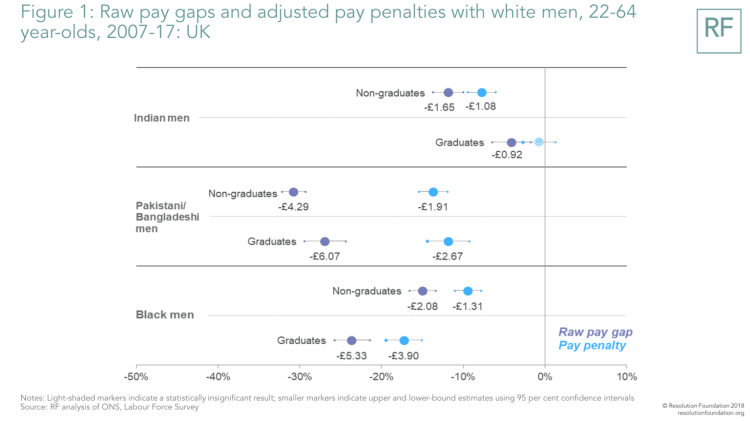
Getting a handle on the size, causes of, and responses to ethnicity pay inequalities is of critical importance. A proportion of the hourly ‘pay gaps’ experienced in recent years can be explained by differences in personal and work-related characteristics that exist between groups, such as region, education to occupation, industry and contract type. However, the report found that even after such factors are taken into account, large ‘pay penalties’ persist. For instance, the 31 per cent pay gap experienced by non-graduate Pakistani and Bangladeshi men halved to a pay penalty of 14 per cent, (-£1.91 per hour) once background factors were accounted for.1 That’s still a huge pay penalty. It was bigger still for black graduate men, who faced the biggest pay penalty of 17 per cent (-£3.90) after adjustments.
Chosen excerpts by Job Market Monitor. Read the whole story at The £3.2bn pay penalty facing black and ethnic minority workers – Resolution Foundation



 Job Market Monitor
Discussion
No comments yet.