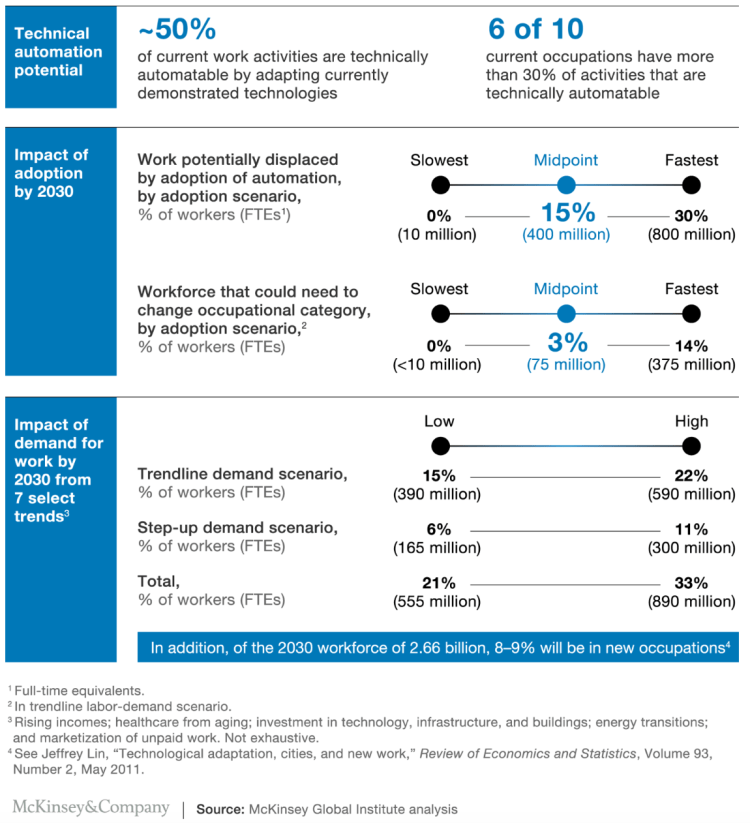
Building on our January 2017 report on automation, McKinsey Global Institute’s latest report, Jobs lost, jobs gained: Workforce transitions in a time of automation (PDF–5MB), assesses the number and types of jobs that might be created under different scenarios through 2030 and compares that to the jobs that could be lost to automation.
The results reveal a rich mosaic of potential shifts in occupations in the years ahead, with important implications for workforce skills and wages. Our key finding is that while there may be enough work to maintain full employment to 2030 under most scenarios, the transitions will be very challenging—matching or even exceeding the scale of shifts out of agriculture and manufacturing we have seen in the past.
Chosen excerpts by Job Market Monitor. Read the whole story at What the future of work will mean for jobs, skills, and wages: Jobs lost, jobs gained | McKinsey



 Job Market Monitor
Discussion
Trackbacks/Pingbacks
Pingback: Future of Work – Fostering the benefits of new technologies requires good measures of their impact | Job Market Monitor - January 23, 2019
Pingback: The Future of Work in US – Five policy strategies for adjusting to automation | Job Market Monitor - March 4, 2019
Pingback: The Future of Work – Artificial Intelligence (AI) impacts on learning, teaching, and education | Job Market Monitor - April 1, 2019
Pingback: The Future of Work and Skills Acquisition – A shift in mindset is needed | Job Market Monitor - August 21, 2019
Pingback: The Geography of the Future of Work in US – A mosaic of local economies on diverging trajectories | Job Market Monitor - August 31, 2019