A smaller share of people in their prime working years (25-54) are employed now than in decades past, and some have wondered whether disabilities and health problems have played a role in that decline. People with disabilities have much lower employment rates than people without disabilities, and disabilities are one of the most commonly cited reasons for not working. Moreover, a recent Brookings report identified particular subgroups among the out-of-work as having disproportionately high rates of disability.
Nine percent of adults aged 25 to 54, or 11 million Americans, reported at least one of six disabilities in 2016. Some patterns by place and demographics are already well-established: disability is disproportionately concentrated in the Southeast, Midwest and Appalachian areas (the so-called “disability belt”), and people with disabilities disproportionately include people with low levels of education and incomes. But analyses at the metropolitan level are less common, and given the regional nature of labor markets, regional-level data should inform efforts to help people with disabilities.
Metros show wide variation in disability rates
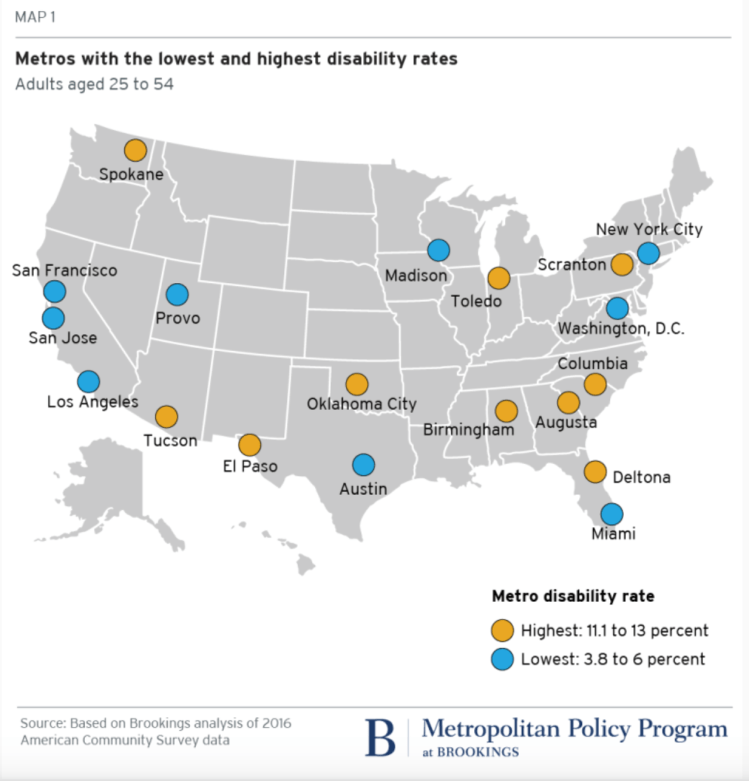
Disability rates range considerably among the country’s 100 largest metropolitan areas, from just under 4 percent up to 13 percent.
Chosen excerpts by Job Market Monitor. Read the whole story at Disability rates among working-age adults are shaped by race, place, and education



 Job Market Monitor
Discussion
No comments yet.