In FY2016, the Japan Institute for Labour Policy and Training (JILPT) conducted a large-scale questionnaire survey to search for evidence on the effects of career counseling. In the survey, subjects were divided into those with past experience of receiving career counseling or similar types of counseling support, and those without such experience. Both groups were then asked extensively about their present awareness, employment status, and working style.
Specifically, the subjects were asked at the start of the survey if they had ever received career or career-related counseling from an expert or specialist in career. They were then divided into those who replied in the affirmative and in the negative, respectively. The former were further asked from whom they had received counseling, with alternatives to choose from: “expert in career counseling (career consultant, career counselor, etc.),” “expert in non-career counseling (general counselor, other counseling supporter)” or “other related personnel (university and other career center staff, company human resources personnel).”
Was career counseling effective?
Traditionally, the effects of career counseling are known to appear most clearly in terms of awareness, such as a sense of satisfaction.
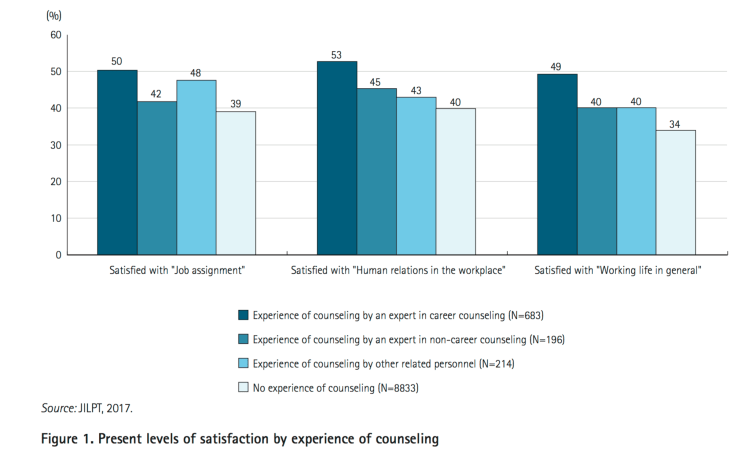
As shown by the results of this survey (Figure 1), the sense of satisfaction with “job assignment,” “human relations in the workplace” and “working life in general” was also highest amongst those with experience of counseling by an expert in career counseling, followed by experience of counseling by an expert in non-career counseling, experience of counseling by other related personnel, and finally no experience of counseling, in that order. The survey also asked about respondents’ satisfaction with “income,” “status at work” and “life at present in general,” but all followed the same trend. Figure 1 shows that satisfaction with “job assignment” was also unusually high for “other personnel,” but this includes human resources personnel and others in the company in question. The inference is that satisfaction with “job assignment” became higher when some form of internal counseling was used.
This survey found evidence not only of effects in terms of awareness, but also of employment status that are somewhat closer to objective indicators.
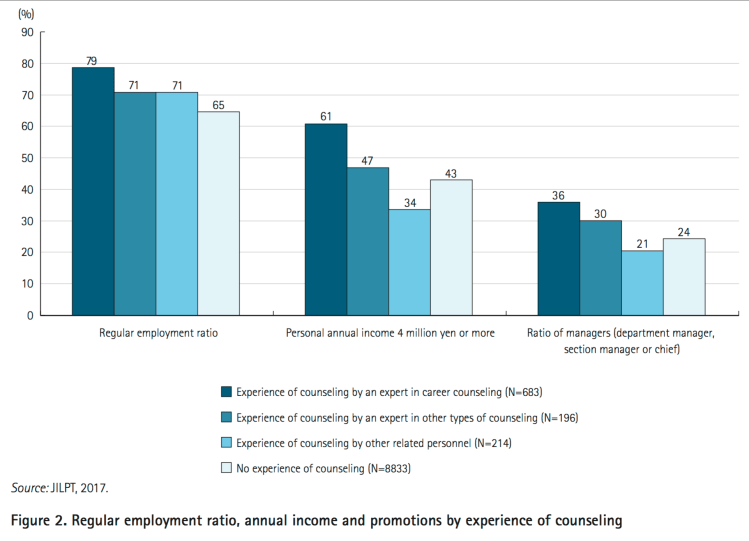
As shown in Figure 2, a high ratio of persons with experience of counseling by counseling experts in career were currently working as regular employees, and a high ratio of them had an annual personal income of 4 million yen or more. A high ratio of those working in an organization had also experienced promotions.
The survey respondents were also asked about when they had experienced counseling. Answers were 3.8 years before for those with “experience of counseling by an expert in career counseling,” 4.1 years before for those with “experience of counseling by an expert in non-career counseling,” and 4.1 years before for those with “experience of counseling by other related personnel.” Thus, there was no statistically significant difference between them. As such, we may see this survey as reflecting how subsequent working life is impacted by having or not having had experience of counseling around four years earlier.
From the results so far, then, we could say that people with experience of counseling by an expert in career counseling are shown to be in a better situation at the present time, to a certain extent, in terms of indicators such as satisfaction, regular employment ratios, annual income and promotion.
Chosen excerpts by Job Market Monitor. Read the whole story at Is Career Counseling Effective?



 Job Market Monitor
Discussion
Trackbacks/Pingbacks
Pingback: Career Guidance in Canada – The truth is that Canada has a “fail-first” approach | Job Market Monitor - March 8, 2022