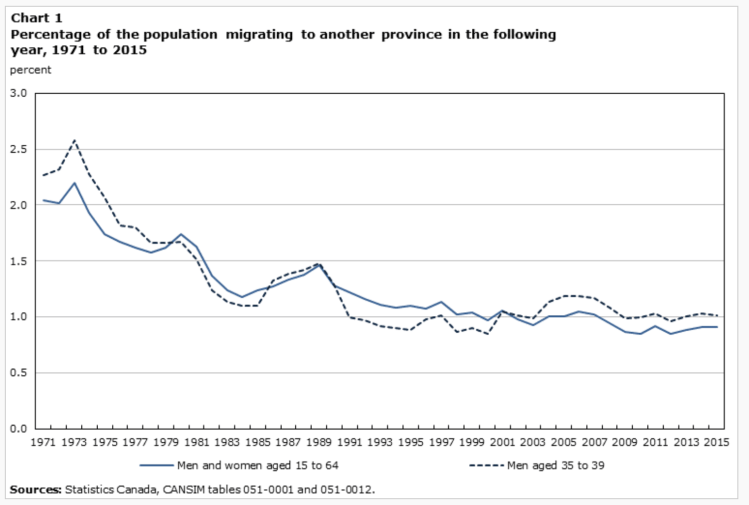
Over the past five decades, the percentage of the working-age population migrating to other provinces has fallen from roughly 2% in the early 1970s to roughly 1% in 2015 (Chart 1). Part of the drop likely reflects the growing number of older workers in the labour force—such workers are less mobile than their younger counterparts. However, the aging of the workforce cannot fully account for this trend, since interprovincial mobility has also dropped within age–gender cells. For example, men aged 35 to 39 experienced a very similar drop in interprovincial mobility during the same period (Chart 1).
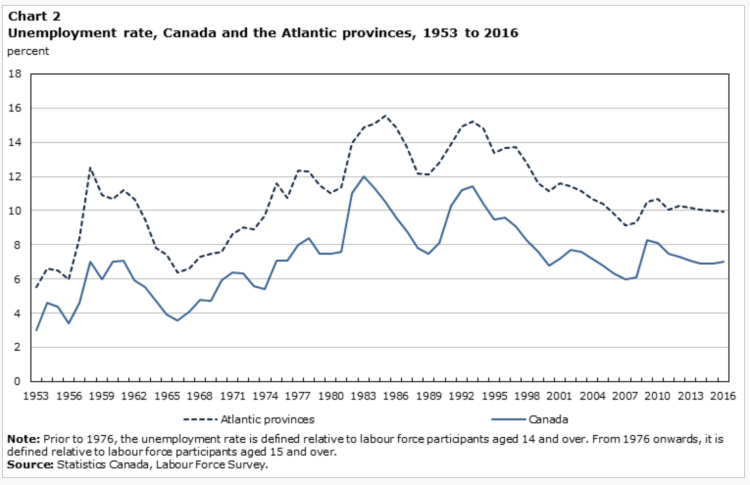
Because regional differences in unemployment rates are persistent (Chart 2), economists have long analyzed the factors that might inhibit or foster labour mobility in Canada and have discussed whether labour mobility in Canada is sufficiently high. It is generally accepted that spatial differences in earnings growth and employment opportunities might induce greater labour mobility from economically depressed areas to dynamic areas, while relatively generous transfer payments in high-unemployment areas might inhibit such mobility.
While economic theory has long emphasized the potential role that regional differences in employment, wages and the social safety net might play, another branch of the literature has documented a robust positive association between social capital (e.g., family, friends, community ties and neighbourhood) and well-being. If this positive association partly captures the causal impact of social capital on individuals’ well-being, and if labour mobility entails—at least temporarily—a disruption of one’s social capital, then having a strong social network might reduce one’s willingness to move to new areas. Hence, social as well as economic factors might act as barriers to labour mobility.Note
In 2016, the majority of unemployed individuals indicated that they would not move to another province or elsewhere in their province for a job offer. The study finds that the main reasons are the desire to stay close to family and friends, or to take care of relatives, or that the spouse or children would not want to move. The study highlights that social considerations as well as economic ones matter in Canadians’ decisions to relocate for employment. The data come from the 2016 General Social Survey and pertain to unemployed individuals aged 15 to 64 who are not students.
Chosen excerpts by Job Market Monitor. Read the whole story at Barriers to Labour Mobility in Canada: Survey-based Evidence



 Job Market Monitor
Discussion
No comments yet.