Comparing the Three Scenarios
In the Status Quo scenario, real GDP grows by an average annual rate of 1.85 per cent between 2017 and 2040. Under the medium immigration scenario, the 450,000 immigrants arriving in Canada in 2040 contribute 0.45 percentage points to average annual real GDP growth of 1.94 per cent over the forecast period (about one-quarter of growth). in the High immigration scenario, the 528,000 immigrants arriving in Canada in 2040 contribute 0.66 percentage points to average annual real gDp growth of 2.05 per cent over the forecast (nearly one-third of growth).
In all three scenarios, real GDP per capita rises. It is highest in the Status Quo scenario, increasing from $50,087 in 2017 to $62,901 in 2040, compared to the medium ($62,348) and high ($61,628) scenarios for 2040. To some extent, though, the medium and high scenarios would better alleviate the economic and fiscal pressures of an aging population and low birth rate. in comparison to the Status Quo scenario, the medium and high scenarios would reduce the population share aged 65 and over, health care costs as a share of provincial revenues, and slightly improve the workers-per-retiree ratio. immigrants would likely require less health care than average since they are about 12 years younger than the national average age, which means the medium and high scenarios could help reduce fiscal pressures on the health care system. Based on our assumptions, governments would have more revenues—due to the higher immigration levels resulting in more people and workers in the economy—and would also be able to direct more spending towards other priorities. in theory, this would benefit more people compared to having a greater share of spending directed to health care under the Status Quo scenario.
The medium and high scenarios create economic and fiscal pressures of their own, however. For instance, Canada’s social expenditures would rise with more immigrants arriving and a larger population overall.
The Elements of a Strong Immigration System
It is critical to stress that higher immigration levels will only create the anticipated benefits if newcomers have good economic outcomes.
Simply upping the inflow but not addressing the challenges that current immigrants face could, in fact, lead to economic costs and risk decreasing public support for immigration. Hence, moving forward, maintaining a successful immigration system will depend on three major factors.
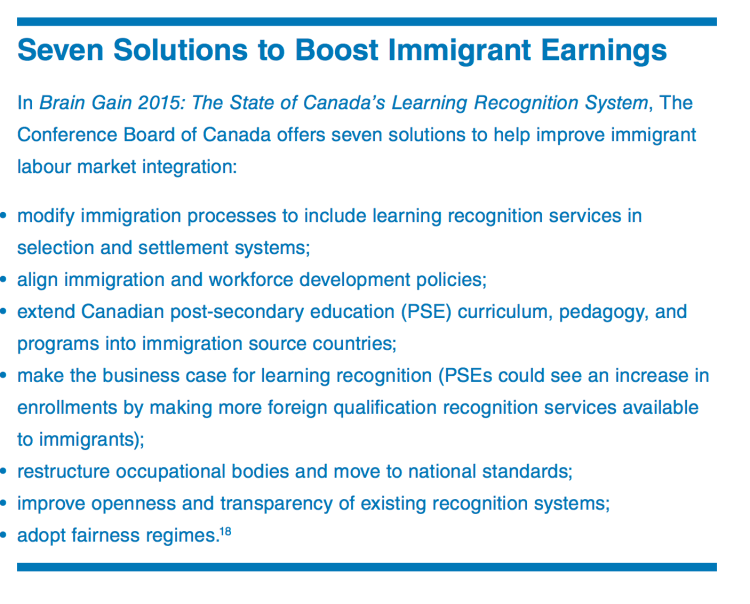
First, with immigration such an important component of growth, Canada needs to improve the labour market outcomes of immigrants—for their benefit and to enhance Canada’s overall economic performance.
Second, Canada will need to expand its absorptive capacity so that newcomers can effectively integrate economically and socially. This entails identifying measures to grow Canada’s economy so that Canadians and immigrants alike have access to good job opportunities, and can generate enough economic activity and government revenues to contribute to the social welfare programs that support the country’s high living standards.
Finally, and most importantly, support for immigration by the Canadian public must be maintained. Future public support is related to Canadians having access to high-quality job opportunities and social welfare programs, and immigrants continuing to contribute to the economy. moreover, Canada’s ability to “manage” the flow of newcomers is also important. informed public discussions are also essential to help guide improvements to, and increase public trust in, the immigration system.
Chosen excerpts by Job Market Monitor. Read the whole story at 450,000 Immigrants Annually? Integration is Imperative to Growth



 Job Market Monitor
Can immigrants get government jobs in Canada? Because everyone wants to migrate to Canada. There are many skilled people who had migrated to Canada who want a government job. So, is there any criteria for immigrants to get Government job?
If there are any government jobs in Canada than please guide me.
Posted by Awais Khan | June 12, 2020, 11:32 am