Employment outcomes across HEIs and subjects
Figure 5 shows the distribution of each institution’s proportion of graduates in sustained employment, further study or both five years after graduation. While median proportions lie consistently between 75% and 85% across subjects, there is significant variation within subjects. For Subjects Allied to Medicine (excluding Nursing), for example, the difference between the highest and lowest proportion reaches 51 percentage points. The lowest median proportion is for those who studied languages. It is possible, however, that graduates of such courses are more likely to be living (and working) abroad five years after graduation. If so, they would be more likely to appear in the ‘activity not known’ category.
Figure 5: Distribution of proportion in sustained employment, further study or both across HEIs for each subject area five years after graduation (minimum, lower quartile, median, upper quartile, maximum).
Female + male graduates, graduating cohort 2008/09

Earnings outcomes across HEIs and subjects
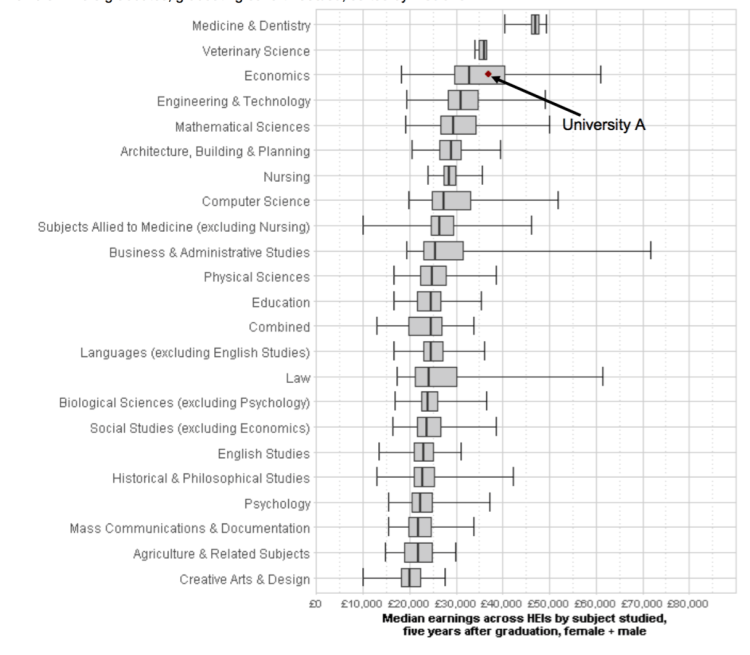
In Figure 2, we present the distribution of median earnings across institutions for each subject five years after graduation. These charts show the spread of median earnings across institutions offering a given subject. They are not to be confused with the earnings distributions of graduates of a given subject. Figure 3 provides guidance on how to interpret the chart in Figure 2.
Figure 2: Distribution of median annualised earnings across HEIs for each subject area five years after graduation (minimum, lower quartile, median, upper quartile, maximum). ‘University A’ represents an example institution.
Female + male graduates, graduating cohort 2008/09, sorted by medians
Chosen excerpts by Job Market Monitor. Read the whole story at Graduate outcomes for all subjects by university – GOV.UK



 Job Market Monitor
Discussion
No comments yet.