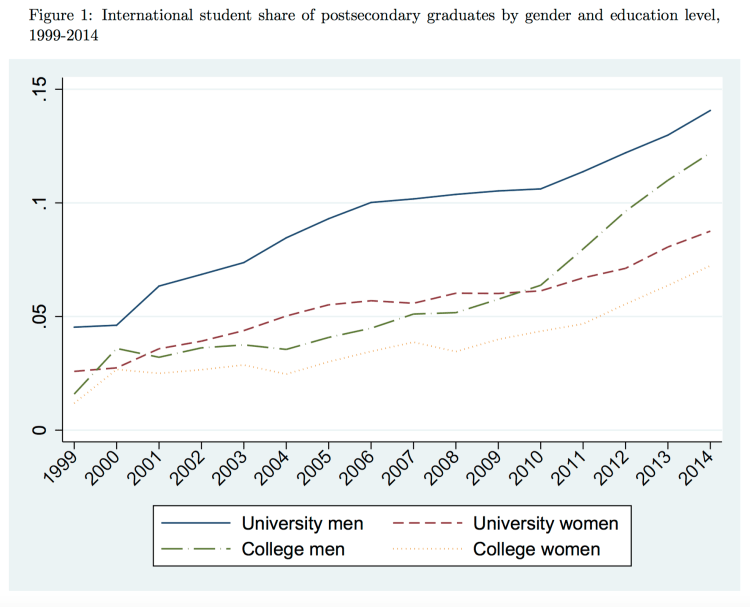
In response to substantial provincial funding cuts through the 1990s combined with a declining postsecondary-aged domestic student population, Canada’s postsecondary institutions are increasingly tapping into the international student market for their tuition revenues. Complementing this increase, the Canadian government has in recent years made a number of important changes to its immigration policies easing the transition of international students to permanent residency. Consequently, by 2014, international students accounted for 10% of graduates from Canadian post- secondary institutions, up from 3% in 2000, and 11% of new permanent residents, up from 7% in 2010. In justifying the government’s preference for international students, former Minister of Immigration, John McCallum, argued: “international students are the best source of immigrants, in the sense that they’re educated, they speak English or French, and they know something of the country. So we should be doing everything we can do to court them.”
This article compares the labour market performance of former international students (FISs) entering the Canadian labour market during the first decade of the 2000s to their Canadian-born-and-educated (CBE) and foreign-born-and-educated (FBE) counterparts.
There are three main findings from our analysis. First, FISs clearly outperform their foreign-educated counterparts by substantial margins. Moreover, the advantage of Canadian over foreign postsecondary education is evident for men and women, across post-secondary education levels, and the regions of origin of immigrants. Second, we find that the average labour market outcomes of FISs lag behind their Canadian-born counterparts when we compare FISs and domestic students graduating from similar academic programs. The performance gaps we identify tend to be larger for college-educated women, in fields outside of math and computer science, among Chinese men and South-Asian women, and at the lower end of the earnings distribution than at the top. Third, we find some evidence, particularly among women, that the relative labour market performance of FISs has tended to deteriorate over time, although the declines are modest in magnitude.
Unfortunately, we are unable to determine to what extent the performance gaps of FISs relative to their Canadian-born counterparts reflect something about FISs students themselves, such as their relative English-French language skills, as opposed to something about their relative labour market experiences as immigrants, such as that they are more likely to face labour market dis- crimination or that they will tend to have weaker social networks to access in their job search efforts. However, the fact that the deterioration in FIS outcomes is evident in the comparison to both Canadian-born-and educated graduates and foreign-educated immigrants suggests to us that it reflects something about FISs as opposed to changing labour market conditions, since there is no clear reason why Canadian-born-and-educated graduates or foreign-educated immigrants would not have been similarly adversely affected by changing labour market conditions. The most obvious explanation for this deterioration is a tradeoff in the average labour market quality of foreign students as postsecondary institutions and governments reached deeper into the pools of international students through the 2000s to meet their demands for students and new immigrants without a commensurate increase in the supply of foreign students.
Chosen excerpts by Job Market Monitor. Read the whole story at – IZA – The Relative Labour Market Performance of Former International Students: Evidence from the Canadian National Graduates Survey
Related Posts
International Students in Canadian Universities – Slightly higher than the OECD average
Relative to other countries, in the 2012-2013 school year Canada ranked slightly higher than the OECD average for international students as a proportion of all students for all three levels of study (see Chart 2). In relation to other primarily English speaking countries, Canada has hosted a lower proportion of international students than Australia, the … Continue reading
Germany – International students are leaving
Germany’s foreign students were assumed to be a hot commodity in a country desperate for skilled labor. But inhospitable employers and lack of preparation from their universities are forcing them to leave in droves. A study published this week by the Expert Council of German Foundations on Integration and Migration (SVR) highlighted the gap between … Continue reading
International Students in London – £2.3 billion success story
New research from London First and PwC shows international students are a boon to the UK, bringing a net benefit of £2.3 billion to the UK economy from London universities alone. The report, London Calling: International students’ contribution to Britain’s economic growth, concludes that the capital’s higher education system is an export success story, with 92 … Continue reading
US / International students supported 313,000 jobs in the 2012-2013 academic year
International students in the United States and their families supported 313,000 jobs and contributed US$24 billion to the economy in the 2012-2013 academic year according to the latest estimates by NAFSA: Association of International Educators Continue reading
25% international students in OECD region are from China or India
Individuals from China and India make up one-fourth of total international students in the OECD region, a grouping of mostly developed nations. These students are also an important source of future labour migration, Paris-based think tank OECD said today. “The share of migrants from Asia among immigrants to OECD countries rose from 27 per cent … Continue reading



 Job Market Monitor
Discussion
No comments yet.