Has U.S. school performance been improving over the past two decades? The results of two international tests—the Program for International Student Assessment (PISA) and the Trends in International Mathematics and Science Assessment (TIMSS)—shed some light on this question. Both were administered in 2015, an event that only occurs every 12 years. Inside the 2017 Brown Center Report on American Education, report author Tom Loveless takes advantage of this rare opportunity to illuminate trends in American students’ aptitude compared to previous years and to their international counterparts.
HOW DID THE U.S. PERFORM ON THESE TESTS IN 2015?
The PISA test scores did not bring great news about the American education system, as the United States continues to hover around the international mean for reading and science literacy. On the mathematics literacy section, the U.S. even notched its lowest score to date at 470; this represents a decline from the previous two tests, but it is not statistically significantly different from its first-ever score in 2003. Overall, American PISA scores on all sections have been relatively flat over the test’s history, with no statistically significant change between the score on each section’s first year and the 2015 scores.
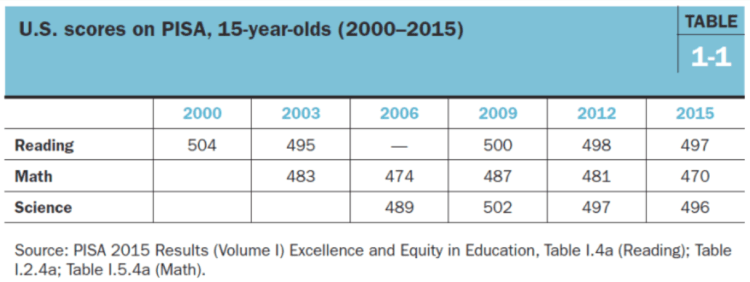
U.S. scores on PISA (2000-2015)
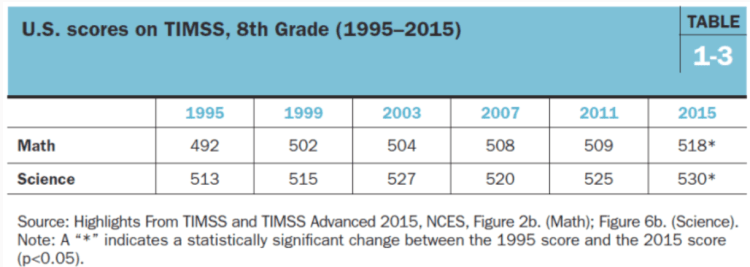
However, the U.S. has consistently performed better on TIMSS. Fourth grade scores have largely stayed above the international mean, with math results improving significantly over time—518 in 1995 grew to 539 in 2015—and science scores remaining steady around 540. Eighth grade TIMSS scores show statistically significant gains in both math and science over the test’s history: Math rose from 492 to 518, while science increased from 513 to 530.

Chosen excerpts by Job Market Monitor. Read the whole story at What international test scores reveal about American education | Brookings Institution



 Job Market Monitor
Discussion
No comments yet.