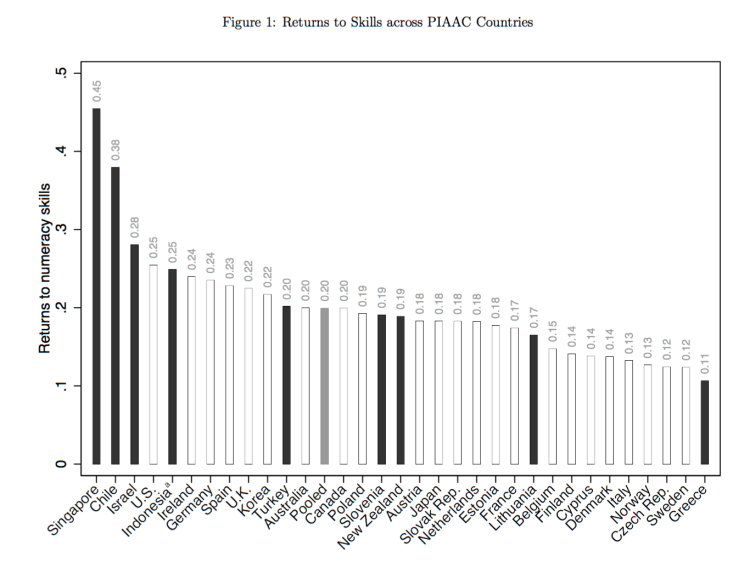
The availability of new information about earnings and skills in a broader set of 32 countries permits closer investigation than previously possible of the hypothesis that education has a stronger payoff when there is faster economic change. It turns out that the range of differences in labor-market returns to skills across countries is even larger than previously thought, with two of the nine newly added countries – Singapore and Chile – having by far the highest returns to skills in the sample and newly added Greece having the lowest. The main observed cross-country pattern is simply that returns to skills are larger in countries with faster prior economic growth, consistent with skilled workers being able to adjust more readily to economic change. These descriptive estimates of course are subject to questions about causality, but considering a range of alternative influences does not change this overall pattern.

Chosen excerpts by Job Market Monitor. Read the whole story at Coping with change: international differences in the returns to skills



 Job Market Monitor
Discussion
No comments yet.