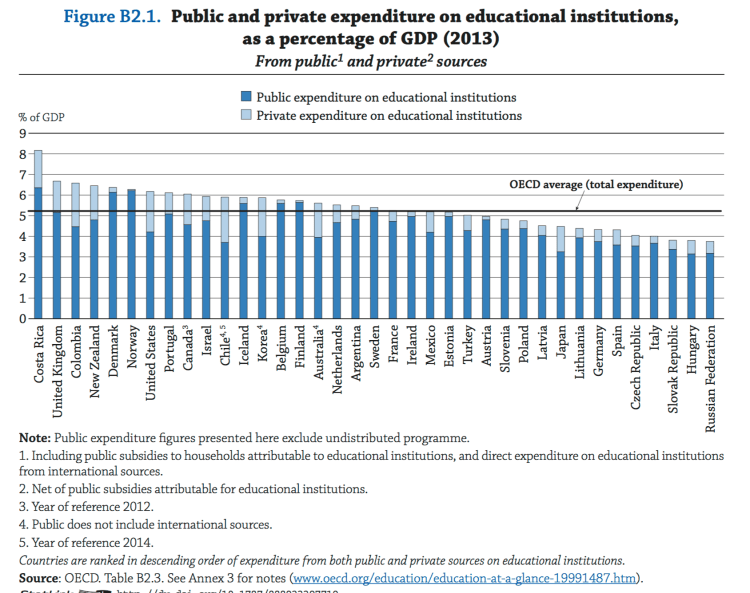
OECD countries spend an average of 5.2% of their GDP on educational institutions from primary to tertiary education, public and private expenditure combined. Around one-third of the total expenditure is devoted to tertiary education, where spending per student is highest. The higher cost of tertiary-level teaching staff and the prevalence of research and development in tertiary education contribute to the high cost.
To ease the strain on already tight public budgets, more countries are shifting the cost of tertiary education from the government to individual households. On average, 30% of the expenditure for tertiary institutions comes from private sources – a much larger share than seen at lower levels of education; and two-thirds of that funding comes from households, often in the form of tuition fees.
Understanding that high fees may prevent eligible students from enrolling in tertiary education, many governments allow for some differentiation in tuition fees. For example, tuition fees may be higher for students attending private institutions or for foreign students, or lower for students in short-cycle tertiary programmes. To support students, many countries also offer scholarships, grants and public or state-guaranteed loans, often with advantageous conditions, to help students cope with the direct and indirect costs of education. Over the past decade, most countries saw an increase in the number of tertiary students taking public or state-guaranteed loans – and graduating with both a diploma and a debt.
Chosen excerpts by Job Market Monitor. Read the whole story at Education at a glance 2016: OECD indicators



 Job Market Monitor
Discussion
No comments yet.