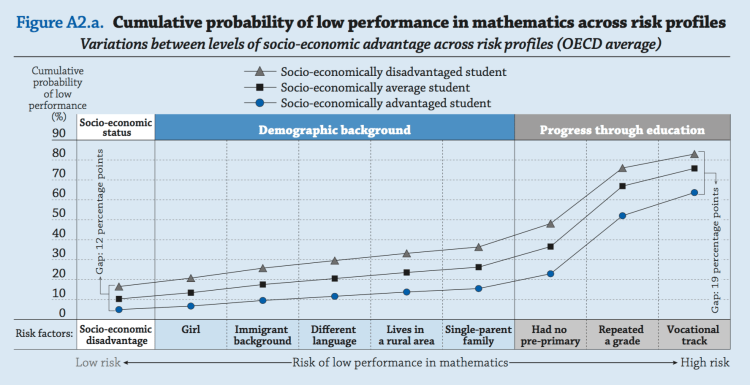
Far too many students around the world are trapped in a vicious circle of poor performance and demotivation that leads only to more bad marks and further disengagement from school. Worse, poor performance at school has long-term consequences, both for the individual and for society as a whole. Students who perform poorly at age 15 face a high risk of dropping out of school without obtaining an upper secondary qualification. When a large share of the population lacks basic skills, a country’s long-term economic growth is also severely compromised (OECD, 2016).
The OECD Programme for International Student Assessment (PISA) defines “low performers” as those who score below Level 2 on the PISA mathematics, reading and/or science scales. These students will find it difficult to leave education systems with an upper secondary qualification. Reducing the number of low-performing students is not only a goal in its own right, but also an effective way to improve an education system’s overall performance – and to boost equity, since low performers are disproportionately from socio-economically disadvantaged families.
Chosen excerpts by Job Market Monitor. Read the whole story at Education at a glance 2016: OECD indicators



 Job Market Monitor
Discussion
No comments yet.