While economic inequality has been one of the hottest topics this presidential campaign season, much of the focus has been on the fortunes of the top 1 percent at the national level. This report, our third annual such analysis, uses the latest available data to examine how the top 1 percent in each state have fared over 1917–2013, with an emphasis on trends over 1928–2013. (Data for additional percentiles spanning 1917–2013 are available at go.epi.org/unequalstates2016data.)
This third edition includes two new elements: We examine top incomes by metropolitan area and county in 2013.
Our analysis provides a number of major findings that confirm the widespread extent and growth of income inequality that is heightening economic anxiety among the American electorate:
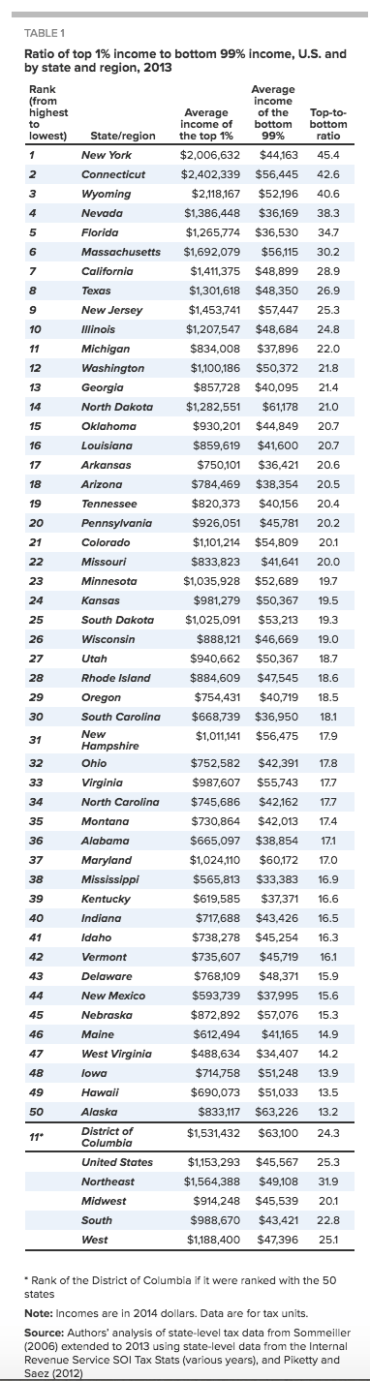
- In 2013, income inequality was much higher in many states, metropolitan areas, and counties than for the United States overall. In 2013 the top 1 percent of families nationally made 25.3 times as much as the bottom 99 percent.
- Nine states had gaps wider than the national gap. In the most unequal states—New York, Connecticut, and Wyoming—the top 1 percent earned average incomes more than 40 times those of the bottom 99 percent.
- Fifty-four of 916 metropolitan areas had gaps wider than the national gap. In the 12 most unequal metropolitan areas, the average income of the top 1 percent was at least 40 times greater than the average income of the bottom 99 percent. Most unequal was the Jackson metropolitan area, which spans Wyoming and Idaho; there the top 1 percent in 2013 earned on average 213 times the average income of the bottom 99 percent of families. The next 11 metropolitan areas with the largest top-to-bottom ratios were Bridgeport-Stamford-Norwalk, Connecticut (73.7); Naples-Immokalee-Marco Island, Florida (73.2); Sebastian-Vero Beach, Florida (63.5); Key West, Florida (58.5); Gardnerville Ranchos, Nevada (46.1); Miami-Fort Lauderdale-West Palm Beach, Florida (45.0); Midland, Texas (44.3); Glenwood Springs, Colorado (42.4); San Angelo, Texas (40.9); Las Vegas-Henderson-Paradise, Nevada (40.7); and Summit Park, Utah (40.3).
- 165 of 3,064 counties had gaps wider than the national gap. The average income of the top 1 percent was at least 45 times greater than the average income of the bottom 99 percent in 25 counties. In Teton, Wyoming (which is one of two counties in the Jackson metropolitan area), the top 1 percent in 2013 earned on average 233 times the average income of the bottom 99 percent of families.
Chosen excerpts by Job Market Monitor. Read the whole story at Income inequality in the U.S. by state, metropolitan area, and county | Economic Policy Institute



 Job Market Monitor
Discussion
No comments yet.