In this paper we argue that involuntary part-time work has been overlooked by research on the dynamics of labor markets, which has mainly focused on unemployment. The notion of involuntary part-time work is closely related to that of unemployment, in that both entail a constraint on workers’ desired labor supply. An individual is considered to be working part-time involuntarily in U.S. statistics if she cannot find a full-time job or faces slack demand conditions in her job. In our view, there are at least two reasons to take this theme seriously. First, the magnitude and cyclical nature of the risk of working part-time involuntarily are comparable to those of unemployment. In fact, during the aftermath of the Great Recession, employed workers were at a greater risk of having to take up involuntary part-time work than of becoming unemployed. Second, from an individual’s perspective, spells of involuntary part-time work seem to spawn a distinct labor market state compared with unemployment. For instance, a full-time worker who takes on a part-time job suffers a large reduction in earnings while remaining employed and is unlikely to receive an income compensation from publicly-provided insurance programs.
Who is working part-time involuntarily and why?
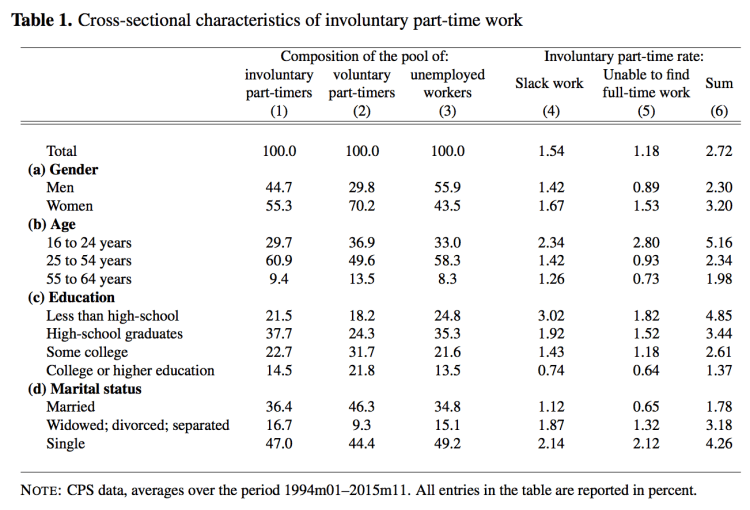
To answer the question above we give a brief description of the population characteristics of involuntary part-time workers during the sample period. To get some perspective, it is useful to compare them to voluntary part-time and unemployed workers. Columns 1 to 3 of Table 1 show how the stocks of involuntary part-timers, voluntary part-timers and unemployed are distributed across different categories of observed dimensions of worker heterogeneity (gender, age, education and marital status). We notice that the composition of the stock of involuntary part-time employment is very similar to that of the unemployment stock across any of the heterogeneity dimensions considered, and strikingly dissimilar to the stock of voluntary part-time workers.
Cyclical behavior
The key observation motivating our analysis is the countercyclical behavior of the involuntary parttime employment rate during the postwar history of the U.S. labor market, and especially its spectacular response during the Great Recession and its aftermath.
To interpret the pronounced countercyclicality of the involuntary part-time employment rate, it is useful to consider the following decomposition:

It highlights that the cyclical behavior of the involuntary part-time employment rate can take place in a number of different ways. In particular, the last term on the right-hand side indicates that, contrary to what we see in Figure 1, the involuntary part-time employment and unemployment rates could even be negatively correlated. In fact, what we find is that the countercyclicality of the left-hand side variable is the result of the prominent countercyclicality of the part-time employment share (a fact documented in BML), and more importantly, the increased incidence of involuntary part-time work during recessions.
Chosen excerpts by Job Market Monitor. Read the whole story at How Bad Is Involuntary Part-time Work?



 Job Market Monitor
Discussion
No comments yet.