A July 2014 Financial Sense article reported that according to the National Federation of Independent Business, an advocacy group for small business, “The proportion of business owners reporting that they can’t find qualified applicants has been trending steeply upward since the end of the recession.” Further, “the most commonly cited shortages are in technical trades such as welding and industrial machinery maintenance, as well as in supervisory and management positions.”
The skills required for these jobs points to where the real work of closing gap needs to happen. In addition to gaps in science, technology, engineering, and math, business leaders say there are also gaps in communication other soft skills.
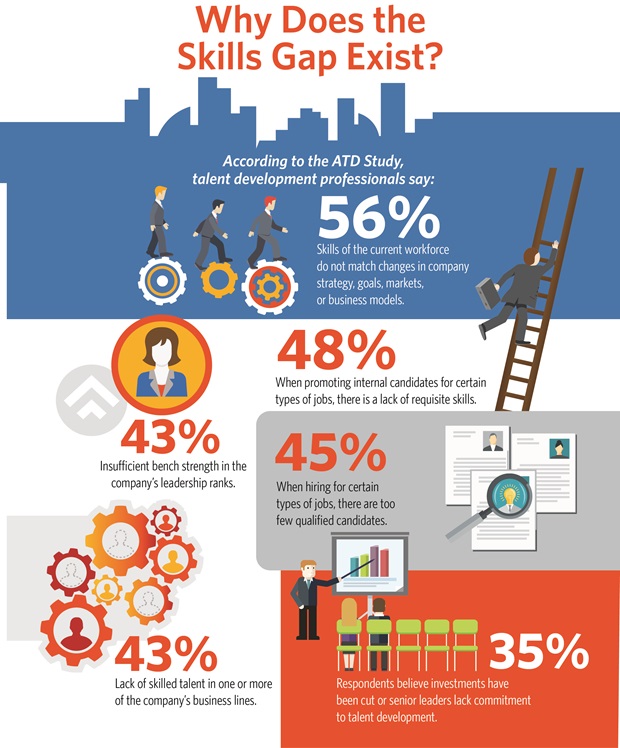
Indeed, the 2015 ATD survey found the following gaps:
• 62%: communication/interpersonal skills
• 58%: managerial/supervisory skills
• 58%: critical thinking and problem-solving skills
• 51%: leadership/executive-level skills
• 50%: process improvement and project management skills
• 41% technical skills.
In a 2013 Adecco Staffing study, “Mind the Skills Gap,” the communication skills gap was noted to be of critical importance, “For all the traditional talk about a skills gap in technical skills, 44 percent of respondents cited soft skills, such as communication, critical thinking, creativity, and collaboration, as the area with the largest gap.” And this type of training needs to be taught alongside industry-specific and STEM skills, “Leaving college knowing how to do a specific job but not having developed stronger critical thinking and communication skills is a real disservice to students—universities need to ensure they offer a balanced education, regardless of an individual’s major or field of study.”
Chosen excerpts by Job Market Monitor. Read the whole story at Bridging the Skills Gap



 Job Market Monitor
Discussion
Trackbacks/Pingbacks
Pingback: Skills Gap in US – The next generation of workers won’t be able to fill the void | Job Market Monitor - March 5, 2016