Consider two workers who are known to be identical in almost every professionally relevant characteristic, such as education, experience and vocational training. The only relevant characteristic in which they may differ is how well each worker gets along with others and cooperates with directives from supervisors. As an employer, you care about these qualities, but lack the ability to observe them directly. In fact, the only observable difference between the two prospective workers is in their resumes: one worker has remained at the same company for his entire career; the other has changed jobs frequently, making horizontal moves every 1 or 2 years. Based on this information, is it possible to infer which worker has a more positive work attitude—i.e., is more cooperative, loyal and reliable? Our conjecture is that employers will often view frequent job changes as potentially reflective of lower degrees of positive work attitude and will, ceteris paribus, find workers who change jobs frequently less desirable in contexts where work attitude is important.
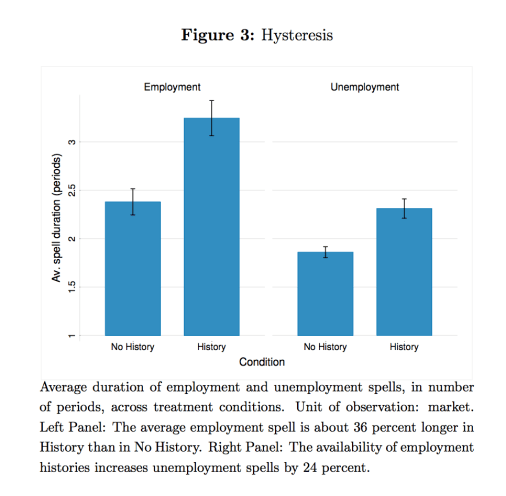
We study whether employment history can provide information about a worker’s noncognitive skills—in particular about “work attitude,” or the ability to work well and cooperatively with others. Our hypothesis is that, holding all else equal, a worker’s frequent job changes can indicate poorer work attitude, and that this information can be transmitted in labor markets through employment histories. We provide support for this hypothesis across three studies that employ complementary lab, field, and survey experiments. First, using a laboratory labor market in which the only valuable characteristic of workers is their reliability in cooperating with an employer’s effort requests, we demonstrate that prior employment information allows employers to screen for such reliability and allows high-reliability workers to obtain better employment outcomes. Second, we conduct a field experiment in which we vary the frequency of job changes in fictitious job applicants’ resumes. Those applicants with fewer job changes are more likely to receive callbacks from prospective employers. A third survey experiment with human resource professionals confirms that the resume manipulations in the field study create different perceptions of work attitude. Our work highlights the potential importance of job history as a signal of worker characteristics, and points to a cost for workers of frequent job changes.
Chosen excerpts by Job Market Monitor. Read the whole story at New working paper “Job History, Work Attitude, and Employability



 Job Market Monitor
Discussion
No comments yet.