Social capital represents social connections and all the benefits they generate. High social capital means a society where people are connected, tolerant, help each other and spend time for the “common good”. They have trust in others and in institutions, and are empowered to shape the society they live in. This has positive impacts on a range of areas, such as personal well-being, health, employment and crime.
Recent government evidence, submitted by the Cabinet Office to the UK Parliament’s Environmental Audit Committee as part of their inquiry on well-being, highlighted the need for better evidence and further in-depth research to better understand social capital. Our current work, as part of the Measuring National Well-being Programme, is helping to better understand social capital, using data from existing sources. This article explores inequalities in social capital by looking at differences in age and sex in the UK using the latest available data. It follows a baseline analysis of social capital in the UK published earlier in the year. It allows policy makers to identify the areas where action may be best targeted to address differences in social capital by age and sex.
Main points
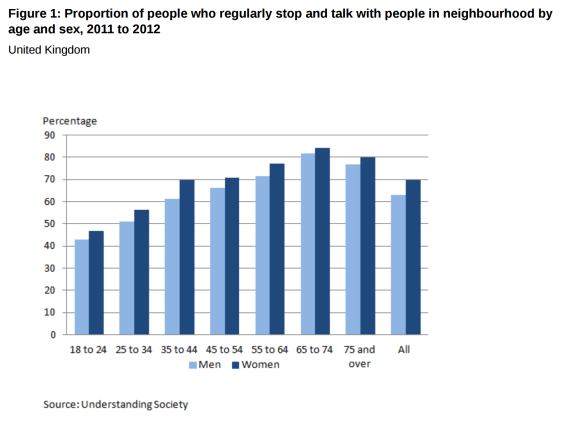
- Young people were the least likely to regularly stop and talk to their neighbours: less than half (45%) of those aged 18 to 24 regularly stopped and talked to their neighbours, compared to around 8 in 10 (83%) people aged 65 to 74 (2011 to 2012).
- Young people were the least interested in politics: around 4 in 10 (39%) of those aged 18 to 24 reported being quite or very interested in politics, compared to just under two-thirds (64%) of those aged 65 to74 (2012 to 2013).
- People aged 75 and over were the least likely to have at least one close friend; 11% of them reported having no close friend at all, compared to 2% of those aged 18 to 24 (2011 to 2012).
- Around 1 in 4 women (24%) and in 1 in 5 men (19%) aged 75 and over reported caring for someone sick, disabled or elderly within their household (2012 to 2013).
- Middle aged people (aged 45 to 54) were the most likely to feel lonely of all age groups (15% in 2011 to 2012) and the least likely to socialise, with nearly half (49%) reporting meeting socially with family, friends or colleagues less than once a week (2012 to 2013).
- Fewer women than men reported feeling safe walking alone in their local area (58% compared to 85% in 2013 to 2014).
Chosen excerpts by Job Market Monitor. Read the whole story at Inequalities in Social Capital by Age and Sex, July 2015 – ONS.



 Job Market Monitor
Discussion
No comments yet.