With expenditure on staff turnover in just 5 sectors costing UK business more than £4 billion each year and the average cost of replacing individual employees estimated at £30,000, Business Disability Forum (BDF) is thrilled to release the first ever report about the skills, confidence and practices that help retain and develop employees with disabilities and long term health conditions across private, public and third sector employers in the UK.
KEY FINDINGS
Key aids and barriersto retaining and developing employees with disabilities
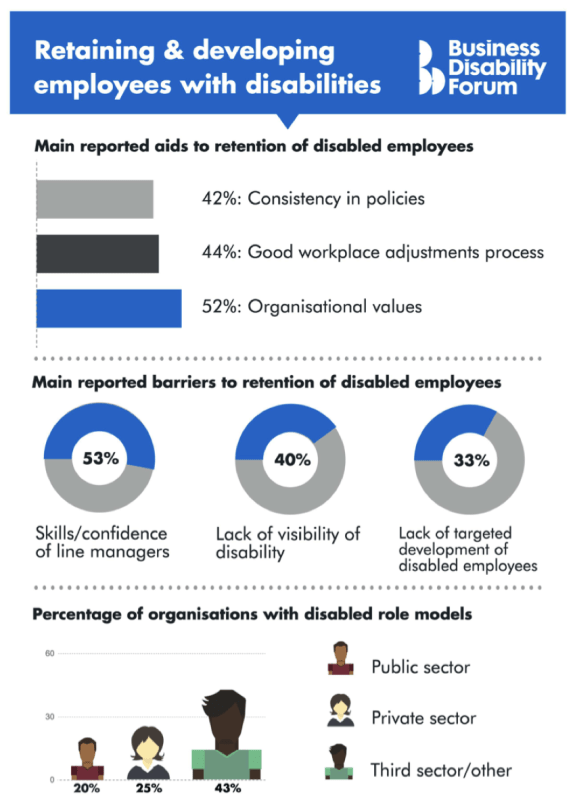
1. Across all organisation types, the biggest aids to an organisation retaining and developing employees with disabilities and long term health conditions are:
a. For half of all private, public and third sector employers, organisational values that prioritise improving disability performance was rated most important.
b. Close to half of all employers identified that good quality workplace or ‘reasonable’ adjustment processes was important.
c. Ensuring consistency in policies so that individual line managers were not left to operationalise policies such as disability related absence or workplace adjustments are also seen as key by more than two in five employers including more than half of all public sector employers.
a. For more than half of all private and public employers, a lack of skilled and confident line managers, with 13 in 20 public sector employers identifying this as one of the three biggest barriers.
b. For two in five of all employers, not knowing or knowing too few disabled people within the organisation was a key barrier, with half of all private sector employers identifying this as a primary barrier.
c. One in three employers cite a lack of targeted development of employees with disabilities and long term health conditions as amajor barrier. This concern about the lack of development was cited as a key barrier for two in five third sector employers.
Chosen excerpts by Job Market Monitor. Read the whole story at State of the Nation report: Retaining and developing employees with disabilities – Business Disability Forum.
Related Posts
Persons with a Disability in US – 17.1 percent were employed vs 64.6 percent for those without
In 2014, 17.1 percent of persons with a disability were employed, the U.S. Bureau of Labor Statistics reported today. In contrast, the employment-population ratio for those without a disability was 64.6 percent. The ratio for persons with a disability declined by 0.5 percentage point from 2013 to 2014, while the ratio for those with no disability increased by 0.6 … Continue reading
People with Disabilities in US – Recruiting, Hiring, Retaining, and Promoting: A guide for employers
This resource guide identifies relevant federal and federally funded resources for employers looking to recruit, hire, retain, and promote people with disabilities. It is designed to answer common questions raised by employers and to identify relevant resources for employers who want additional information on specific topics. The goal of this guide is to help employers … Continue reading
Disabled in Canada – The employment rate aged for 25 to 64 was 49% in 2011 compared with 79% for those without a disability
The employment rate of Canadians aged 25 to 64 with disabilities was 49% in 2011, compared with 79% for Canadians without a disability. Among those with a ‘very severe’ disability, the employment rate was 26%. Canadians with disabilities include those with a physical or mental disability related to seeing, hearing, mobility, flexibility, dexterity, pain, learning, development, psychological/mental disorders or memory. More than two … Continue reading
Disabilities – ‘We haven’t found a disability we can’t employ’ says former senior vice-president at US retailer Walgreens
“Let me tell you a story,” says Randy Lewis, former senior vice-president at US retailer Walgreens, in a Texan drawl. And it’s quite a story. It’s the tale of how a man who led logistics at America’s largest drug-store chain, supporting it as it grew from 1,600 to 8,000 outlets with the most advanced … Continue reading



 Job Market Monitor
Discussion
No comments yet.