This article assessed the relative importance of interprovincial paid employment from the perspective of sending and receiving provinces of interprovincial employees. After a steady rise from 2002 to 2008, the number of interprovincial employees fell in 2009, but increased thereafter. By 2011, interprovincial employees accounted for 3% of employees in Canada, and 9% to 11% of the paid workforce residing in Newfoundland and Labrador, Yukon, and Nunavut.
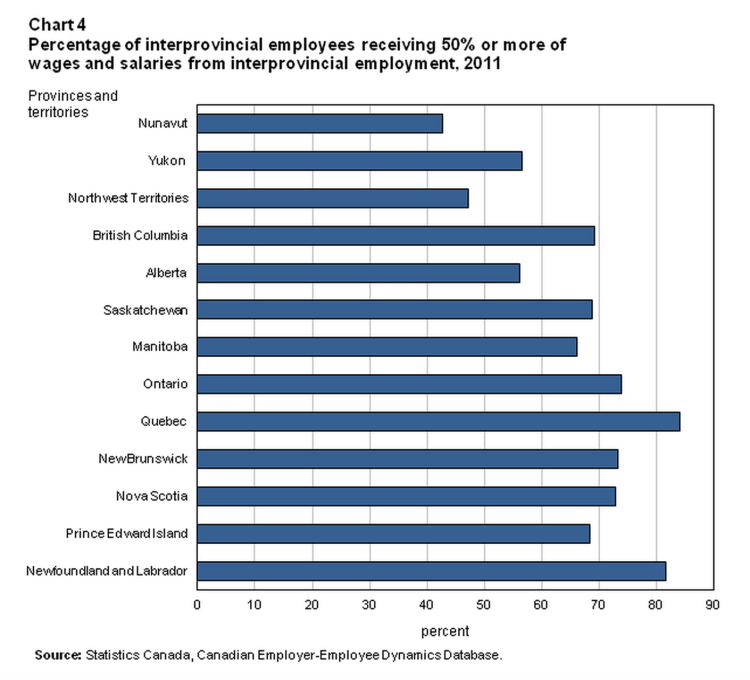
In recent years, wages and salaries earned in other provinces made up a substantial percentage of aggregate earnings of residents of Saskatchewan, Yukon and the Atlantic provinces, especially Newfoundland and Labrador. Wages and salaries earned in other provinces were also the main source of employment income for the majority of interprovincial employees, indicating that interprovincial employment is, at least temporarily, a key determinant of the living standards of a subset of the workforce.
Men were more likely than women to be interprovincial employees, and male interprovincial employees received a larger share of their total earnings from interprovincial employment than women did. For both sexes, employees younger than 25 were more likely to be interprovincial employees than were those aged 25 or older, but obtained a smaller share of their earnings from interprovincial employment.
Of all provinces receiving interprovincial employees, Saskatchewan had the largest share of employment income paid to interprovincial employees in 2011 (4.5%). Using this metric, interprovincial employment played an even larger role in the territories.
The data in this article are cross-sectional, and do not indicate whether spells of interprovincial employment are of short or long duration. As well, the series ends in 2011 and does not capture the impact of changing economic conditions since 2011, including the recent sharp drop in world oil prices (since the mid-2014) on the number of interprovincial employees. Investigating these issues as more recent data become available is a task for future analyses.
Chosen excerpts by Job Market Monitor. Read the whole story at Interprovincial Employment in Canada, 2002 to 2011.



 Job Market Monitor
Discussion
No comments yet.