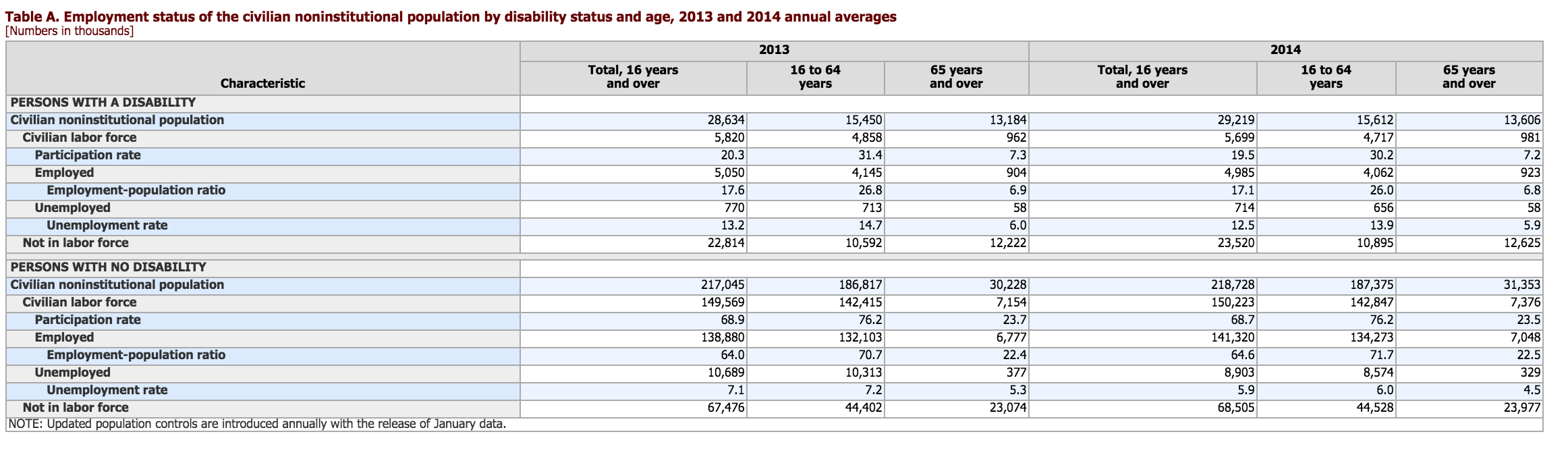
In 2014, 17.1 percent of persons with a disability were employed, the U.S. Bureau of Labor Statistics reported today. In contrast, the employment-population ratio for those without a disability was 64.6 percent. The ratio for persons with a disability declined by 0.5 percentage point from 2013 to 2014, while the ratio for those with no disability increased by 0.6 percentage point. The unemployment rate of persons with a disability edged down to 12.5 percent from 2013 to 2014, while the rate for those without a disability declined to 5.9 percent.
The data on persons with a disability are collected as part of the Current Population Survey (CPS), a monthly sample survey of about 60,000 households that provides statistics on employment and unemployment in the United States. The collection of data on persons with a disability is sponsored by the Department of Labor’s Office of Disability Employment Policy.
Highlights from the 2014 data:
–Persons with a disability were about three times as likely as those with no disability to be age 65 and over.
–For all age groups, the employment-population ratio was much lower for persons with a disability than for those with no disability.
–Unemployment rates were higher for persons with a disability than for those with no disability among all educational attainment groups.
–In 2014, 33 percent of workers with a disability were employed part time, compared with 18 percent for those with no disability.
–Employed persons with a disability were more likely to be self-employed than those with no disability.
Chosen excerpts by Job Market Monitor. Read the whole story at Persons with a Disability: Labor Force Characteristics News Release.



 Job Market Monitor
Discussion
Trackbacks/Pingbacks
Pingback: UK – Retaining and developing employees with disabilities – A Report | Job Market Monitor - July 3, 2015