Studies on job growth typically seek answers to questions such as: What is the source of the growth of jobs? Does job growth lie predominantly in small, large, young or old firms? Where is job growth strongest? Where is it most volatile?
An earlier Statistics Canada study, published in The Daily on July 5, 2012, showed that the average annual rate of job growth does not differ significantly for firms of different sizes once the age of the firm is taken into account.
A new study looks at whether large positive or negative growth rates can be found among growing and declining firms. The study moves beyond examining average job growth rates to examining the variability in the distributions of the growth rates of firms of different sizes and ages. In doing so, it looks at the extent to which job growth, either positive or negative, is concentrated in what are referred to as high-growth or rapidly shrinking firms.
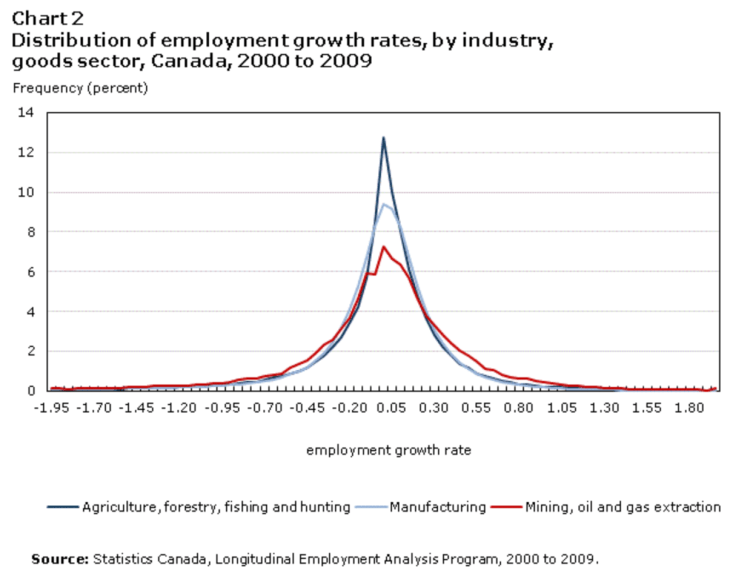
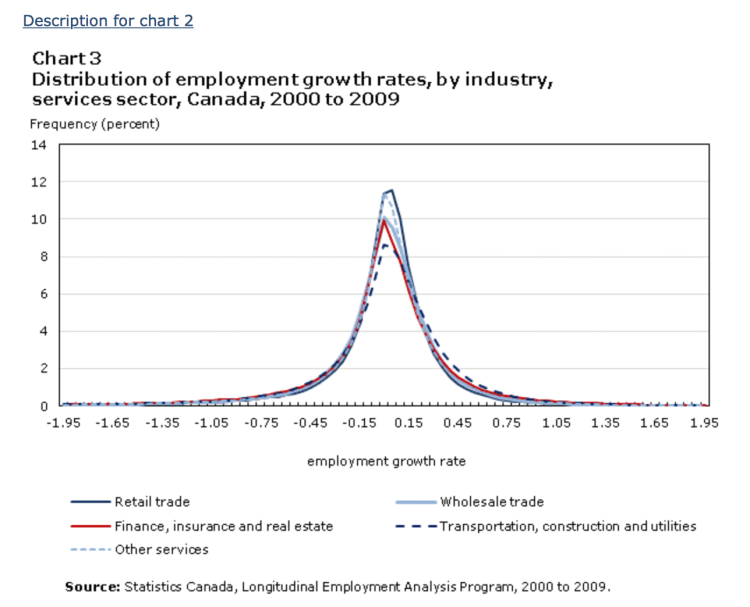
The study finds that the distribution of firm growth is peaked around zero, but has more density in the extremes than the normal distribution. The shape of the distribution reflects the fact that most firms exhibit little organic growth, regardless of industry, size or age. On the other hand, a small number of firms with very high rates of employment growth or destruction account for a disproportionate share of the overall employment dynamics in the Canadian economy. Quantile regressions reveal that age is a factor in high growth: regardless of size, younger firms are more likely to post high growth rates. Size, by contrast, is a factor in the probability of decline, with smaller firms being more likely to shrink rapidly.
This paper makes three contributions to the literatures on firm growth. A large body of research examines average growth patterns. This study demonstrates that the average tendencies of Canadian firms are driven by the tails of the growth distribution, which is consistent with findings for other countries.
The study’s other contributions are to relate not only high growth, but also rapid decline, to firm characteristics using quantile regression techniques. A growing literature on HGFs and related literatures on gazelles and entrepreneurship study firms in the positive tail of the distribution. This research usually resorts either to case studies of particularly prominent firms, or to defining arbitrary growth thresholds and describing the average characteristics of firms exceeding them. RSFs, on the other hand, have largely been neglected. The present study uses quantile regression to examine the characteristics of firms along the entire distribution of growth outcomes, including HGFs and RSFs, without the need to define arbitrary growth thresholds.
Chosen excerpts by Job Market Monitor. Read the whole story at The Distribution of Employment Growth Rates in Canada: The Role of High-growth and Rapidly Shrinking Firms.



 Job Market Monitor
Discussion
No comments yet.