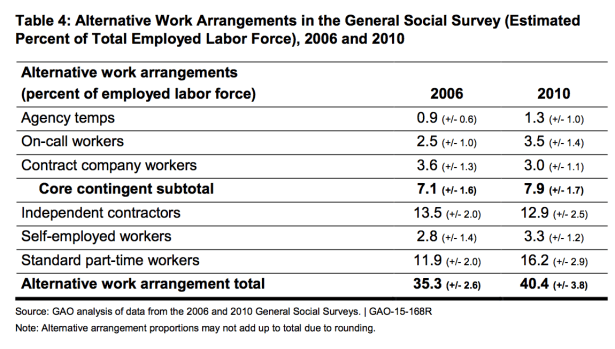
The size of the contingent workforce as a proportion of the total U.S. employed labor force can range widely, depending on how it is defined. Narrower definitions generally focus on employment that is temporary, and can result in estimates of less than 5 percent. Broader definitions include various employment arrangements, such as on-call, part-time, and self-employment, among others, and can result in estimates of more than a third of the labor force. Analyzing a defined core contingent workforce, including agency temps and on-call workers, GAO estimated that this group comprised about 7.9 percent of the employed labor force in 2010.
The characteristics and employment experiences of contingent workers differ from those of standard full-time workers in a number of ways. GAO’s analysis found that core contingent workers are more likely to have no high school degree and have low family income. Contingent workers are also more likely than standard workers to experience job instability, and to be less satisfied with their benefits and employment arrangements than standard full-time workers. For example, GAO estimated that core contingent workers were more than three times as likely as standard full-time workers to report being laid off in the previous year. Evaluating workplace safety for contingent workers is challenging due to a lack of worker injury data that track injuries by job type. However, other research has found that some contingent workers, particularly agency temps, may be at increased risk of injury. According to Department of Labor officials, this increased risk occurs for a variety of reasons, including because agency temps often are not provided adequate safety training or equipment.
Earnings, benefits, and measures of poverty of contingent workers also differ from those of standard full-time workers. Contingent work can be unstable, or may afford fewer worker protections than standard work, depending on a worker’s particular employment arrangement. As a result, contingent work tends to lead to lower earnings, fewer benefits (such as retirement plans and health insurance), and a greater reliance on public assistance. Accounting for other factors that affect earnings, contingent workers earn less than standard workers on an hourly, weekly, and annual basis. GAO found that contingent workers earn about 10.6 percent less per hour than standard workers. Differences in earnings vary by industry and occupation. For example, contingent workers in the education industry earned significantly less annually, weekly, and hourly than similar standard workers, while in the construction industry only the difference in annual earnings was statistically significant. GAO also found that contingent workers are about two-thirds less likely than standard workers to have a work-provided retirement plan and less than half as likely to have work-provided health insurance.
Based on our analysis of the 2010 GSS, the most recent data available, we estimated that 40.4 percent of the employed labor force was in alternative work arrangements; 7.9 percent was in core contingent arrangements—as contract company workers, on-call workers, and agency temps (see table 4).
While family income may be affected by many factors (see sidebar), core contingent workers are generally more likely to report low family incomes than standard full-time workers. As we observed in prior work, the percentage of workers reporting low family income in the 2005 CWS varied considerably by work arrangement.27 The incidence of low family income ranged from 7.6 percent for self-employed workers to 28.4 percent among agency temps (see table 6). Despite this variation, core contingent workers were more likely to report low family income than standard full- time workers—19.8 percent compared to 8.3 percent (see table 6).

Chosen excerpts by Job Market Monitor. Read the whole story at U.S. GAO – Contingent Workforce: Size, Characteristics, Earnings, and Benefits.



 Job Market Monitor
Discussion
No comments yet.