Labor markets around the world have not kept pace with rapid shifts in the global economy, and their inefficiencies take a heavy toll. Millions of people cannot find work, yet sectors from technology to health care cannot find people to fill open positions. Many who do work feel overqualified or underutilized.
Online talent platforms can ease a number of these dysfunctions by more effectively connecting individuals with work opportunities. They include websites (such as Monster.com and LinkedIn) that aggregate individual resumes with job postings from traditional employers as well as the rapidly growing number of digital marketplaces for services, such as Uber and Upwork. Even if these platforms touch only a fraction of the global workforce, they can generate significant benefits for economies and for individuals. While their growth and adoption has been dramatic, they are still evolving in terms of capabilities and potential.
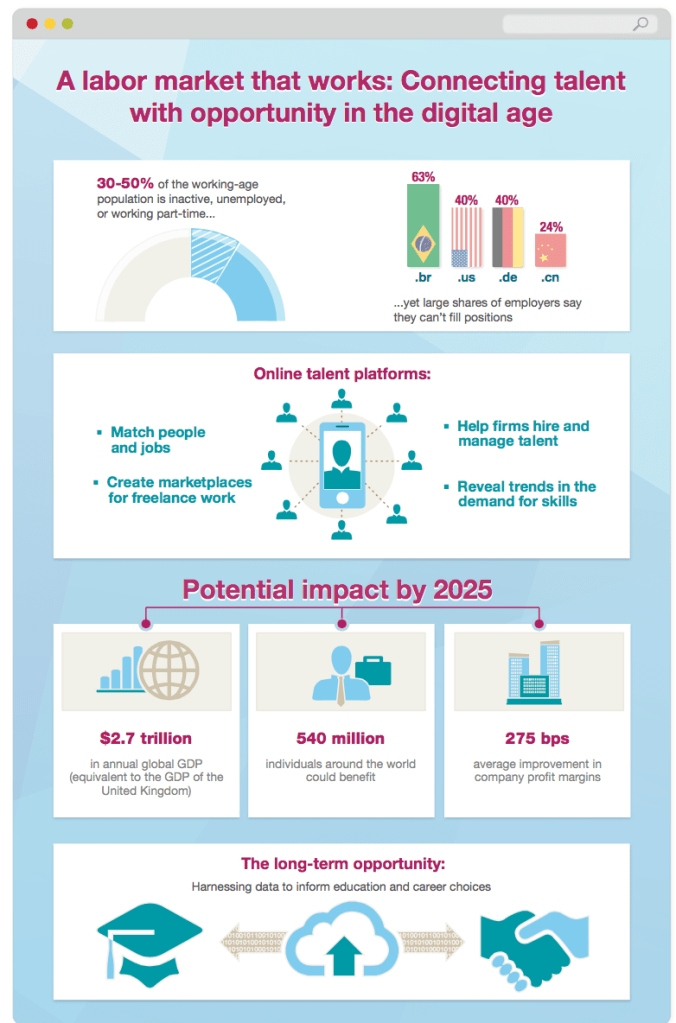
- In countries around the world, 30 to 45 percent of the working-age population is unemployed, inactive in the workforce, or working only part-time. In the United States, the United Kingdom, Germany, Japan, India, Brazil, and China, this amounts to 850 million people.
- Online talent platforms serve as clearinghouses that can inject new momentum into job markets. By 2025, we calculate they could add $2.7 trillion, or 2.0 percent, to global GDP and increase employment by 72 million full-time-equivalent positions.
- Up to 540 million individuals could benefit from online talent platforms by 2025. As many as 230 million could shorten search times between jobs, reducing the duration of unemployment, while 200 million who are inactive or working part-time could work additional hours through freelance platforms. As many as 60 million people could find work that more closely suits their skills or preferences, and another 50 million could shift from informal to formal employment.
- Countries with persistently high unemployment and low participation, such as South Africa, Spain,
and Greece, would potentially benefit most. Among advanced economies, the United States stands to realize significant gains because of the relative fluidity of its job market. By contrast, the relative potential is lower in Japan and China due to low unemployment and other barriers that limit adoption. - Online talent platforms create transparency around the demand for skills, enabling young people to make more informed educational choices. This can create an opportunity to improve the allocation of some $89 billion in annual spending on tertiary education in the United States, the United Kingdom, Germany, Japan, India, Brazil, and China.
- Companies can use online talent platforms to identify and recruit candidates—and then to motivate them and help them become more productive once they start work. We calculate that adoption could increase output by up to 9 percent and reduce costs related to talent and human resources by as much as 7 percent.Capturing this potential will require expanded broadband access, updated labor market regulations, systems for delivering worker benefits, and clearer data ownership and privacy rules. There is also an enormous opportunity to harness the data being gathered by these platforms to produce insights into
the demand for specific skills and occupations as well as the career outcomes associated with particular educational institutions and programs. More accurate and predictive modeling could help individuals make more informed decisions about education, training, and career paths.
Chosen excerpts by Job Market Monitor. Read the whole story at Connecting talent with opportunity in the digital age | McKinsey & Company.



 Job Market Monitor
Discussion
No comments yet.