As the economy of the United States continues to rebound from the Great Recession, the well-being of households and consumers provides important infor- mation about the scope and pace of the economic recovery. In order to monitor the financial and eco- nomic status of American consumers, the Federal Reserve Board began conducting the Survey of Household Economics and Decisionmaking in 2013 and conducted the survey for a second time in Octo- ber 2014. The findings from the October 2014 survey are covered in this report. Topics examined in the survey include the financial health of individuals on a number of levels, such as overall well-being, housing, economic fragility, savings and spending, access to credit, education and student loans, and retirement planning.
Key Findings
Overall, since the previous survey in 2013, individuals and their families experienced only mild improvements in their overall well-being, but they are increasingly optimistic about the trajectory of their well-being going forward.
- Sixty-five percent of respondents report that their families are either “doing okay” or “living comfortably” financially, compared to 62 percent in 2013.
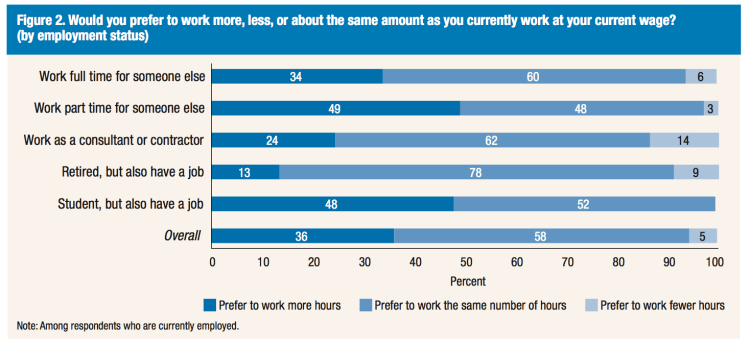
- Forty-nine percent of part-time workers and 36 percent of all workers would prefer to work more hours at their current wage if they were able to do so.
- Twenty-nine percent of respondents expect their income to be higher in the year after the survey than in the year prior to the survey. In the 2013 survey, 21 percent of respondents expected their income to increase.
Employment
Closely related to overall economic well-being is the employment status of respondents. In the survey, 55 percent of respondents report being employed, while 19 percent are retired, 7 percent are homemakers, 7 percent are disabled and not working, and 7 percent are not employed (including both those looking and not looking for work) or are on temporary layoff.
In addition to the rate of unemployment, the level of underemployment is an important measure of labor market slack. One measure of underemployment is the fraction of individuals who are working but would like to work more if they had the opportunity to do so. To gauge the size of this population, the survey asks non-self-employed workers whether they would prefer to work more, less, or the same amount that they currently work if their hourly wage was unchanged. Thirty-six percent of these respondents indicate that they would prefer to work more hours at their current wage. Among those whose current job is part time, the fraction is even higher, with 49 percent responding that they would prefer to work more hours at their current wage (figure 2).
One way that some workers fill this desire for additional income is by working multiple jobs. Among employed respondents, 15 percent report having at least two jobs. This includes 21 percent of respondents who work part time at multiple jobs.
Working multiple jobs is slightly more common among respondents with less income. Conditional on having at least one job, 18 percent of employed respondents whose household income is less than $40,000 per year have at least two jobs, whereas
15 percent of those whose income is between $40,000 and $100,000 and 14 percent of those with a house-hold income over $100,000 have at least two jobs.
Chosen excerpts by Job Market Monitor. Read the whole story at Report on the Economic Well-Being of U.S. Households in 2014, May 2015



 Job Market Monitor
Discussion
No comments yet.