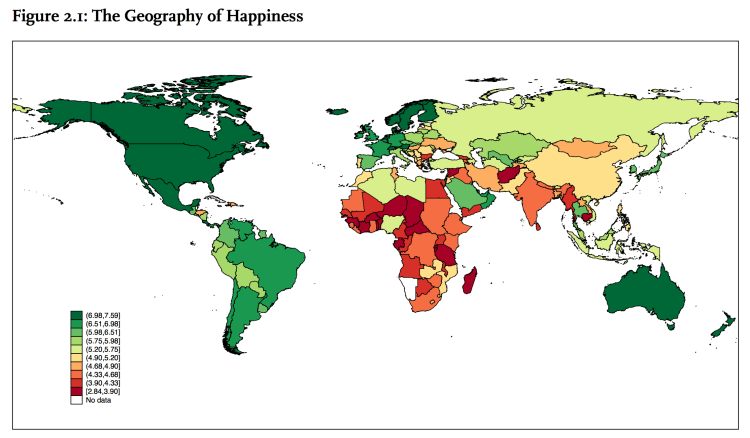
Average life evaluations, where 0 represents the worst possible life and 10 the best possible, range from an average above 7.5 at the top of the rankings to below 3 at the bottom. A difference of 4 points in average life evaluations separates the 10 happiest countries from the 10 least happy countries.
Comparing the country rankings in World Happiness Report 2015 with those in World Happiness Report 2013, there is a combination of consistency and change. Nine of the top 10 countries in 2015 were also in the top 10 of 2013. But the ranking has changed, with Switzerland now at the top, followed closely by Iceland, Denmark and Norway. All four countries have average scores between 7.5 and 7.6, and the differences between them are not statistically significant. The rest of the top 10 (in order) are Canada, Finland, Netherlands, Sweden, New Zealand and Australia, all with average scores above 7.28. There is more turnover, almost half, among the bottom 10 countries, all with average ladder scores below 3.7. Most are in sub-Saharan Africa, with the addition of Afghanistan and a further drop for Syria.
Three-quarters of the differences among countries, and also among regions, is accounted for by differences in six key variables: GDP per capita, healthy years of life expectancy, social support, trust, perceived freedom to make life decisions, and generosity. Differences in social support, incomes, and healthy life expectancy are the three most important factors.
Analysis of changes in life evaluations from 2005-2007 to 2012-2014 shows big international differences in how the global recession affected national happiness. The top three gainers were Nicaragua, Zimbabwe and Ecuador, with increases ranging from 0.97 to 1.12. The biggest drop in average life evaluations was in Greece, which lost almost 1.5 points, followed by Egypt with -1.13 and Italy with -0.76 points. Of the 125 countries with data available for both 2005-2007 and 2012-2014, there were 53 countries with significant improvements, 41 with significant worsening, and 36 without significant change. These differing national experiences appear to be due some combination of differing exposure to the economic crisis and differences in the quality of governance, trust and social support. Countries with sufficiently high quality social capital appear to be able to sustain or even improve subjective well-being in the face of natural disasters or economic shocks, as the shocks provide them an opportunity to discover, use and build upon their communal links. In other cases, the economic crisis triggered drops in happiness greater than could be explained by falling incomes and higher unemployment.
Chosen excerpts by Job Market Monitor. Read the whole story at World Happiness Report 2015



 Job Market Monitor
Discussion
No comments yet.