This research report presents detailed information on the policies and practices in place in state unemployment insurance (UI) programs that provide potential temporary financial assistance to family caregivers. The report draws on legal analysis from 50 states and the District of Columbia and in-depth interviews with advocates and UI agency officials from 10 targeted states that have “caregiver-friendly” UI rules in place.
HIGHLIGHTS OF FINDINGS
- State and federal UI data show that family caregivers are claiming UI, but at very low rates. With more than 65 million Americans acting in caregiver roles across the lifespan and nearly 10 percent reporting that caregiving responsibilities have led them to leave their jobs, it is clear that even where caregiver-friendly UI provisions exist, many family caregivers are not applying for and receiving UI benefits.
- Three categories of UI rules apply to working family caregivers seeking unemployment benefits. These are rules about voluntarily leaving work, discharge for misconduct (or just cause), and availability for work. The specifics of UI caregiving rules in each state determine the extent and nature of support UI programs can offer to working family caregivers.
- Claimants are unlikely to meet availability for work conditions while they are engaged in full-time family caregiving. For this reason, UI benefits are not a substitute for paid leave. However, if family caregiving is provided on a part-time basis and the caregiver is available to work at other times of day, he or she may remain eligible for UI benefits. A worker may also wait to apply for UI until caregiving responsibilities lessen or end.
- All states limit UI benefits to a 1-year period. A caregiver who files a claim at the time of voluntary job termination will have only 52 weeks in which to draw any benefits under that claim. In most cases, once that claim expires, any claim in a later benefit period would require additional employment earnings to qualify for UI benefits.
- In 2009, under the federal UI Modernization program, 19 states expanded UI eligibility to allow benefits for separations from work due to “compelling family circumstances.” The federal government offered financial incentives to states that adopted the provision, which include the need to care for a family member experiencing illness or a disability. Some other states have rules predating UI Modernization that protect eligibility for UI benefits for caregivers.
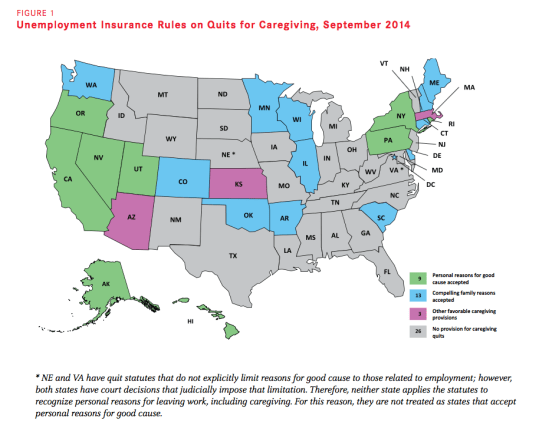
- Almost half of states have UI rules that accommodate workers who leave their jobs voluntarily to act as family caregivers; however, a favorable decision to grant UI benefits is far from automatic. Nine states have UI rules that permit any compelling reason (not just work-related reasons), including compelling family reasons, to serve as good cause for voluntarily quitting a job. Twelve states and the District of Columbia have UI rules that accept compelling family reasons as good cause for quitting a job. Three states have UI rules with other favorable provisions that accommodate family caregivers. In the remaining 26 states, personal reasons, including compelling family circumstances, are disqualifying.
- Awareness of UI rules that accommodate family caregivers is very low. Interviewed agency officials and advocates agreed that many people assume they are ineligible for UI when they quit their jobs, and few are aware of caregiving-friendly provisions. Even where UI rules that accommodate family caregivers exist, implementation is sometimes lacking. Advocates described agency staff (including adjudicators, who make eligibility decisions) lacking training in compelling family circumstances provisions, and state UI “cultures” that lead agencies to disregard the rules. Many UI claimants have no access to legal counsel and limited ability to appeal adverse decisions.
- Unreasonable requirements for family caregivers to engage with their employers prior to quitting often result in denial of benefits even when states have caregiving- friendly rules. Many states have stringent rules in place requiring working caregivers to request accommodations from their employers prior to quitting, sometimes even when such requests would prove futile. Agency officials cited failure to comply with employer engagement rules as one of the most common reasons for denying benefits.
- Employers may be less likely to contest family caregiving–related voluntary quits because they are not directly taxed for employees who quit due to compelling family circumstances. In contrast, when a worker is fired for reasons related to family caregiving concerns, the employer’s UI tax rates are increased.
Chosen excerpts by Job Market Monitor. Read the whole story at Access to Unemployment Insurance Benefits for Family Caregivers – AARP.



 Job Market Monitor
Discussion
No comments yet.