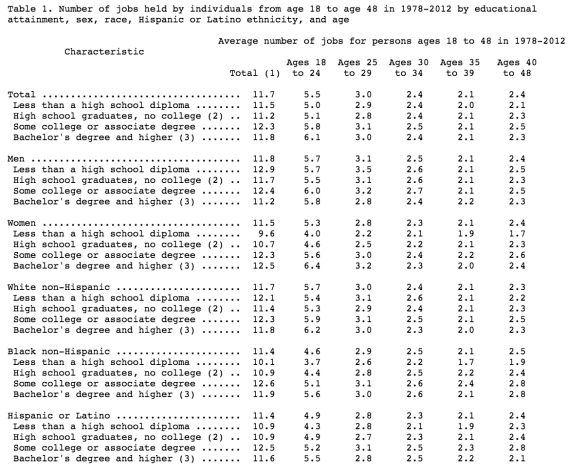
The average person born in the latter years of the baby boom (1957-1964) held 11.7 jobs from age 18 to age 48, according to the U.S. Bureau of Labor Statistics. Nearly half of these jobs were held from ages 18 to 24.
These findings are from the National Longitudinal Survey of Youth 1979; a survey of 9,964 men and women who were ages 14 to 22 when first interviewed in 1979 and ages 47 to 56 when interviewed most recently in 2012-13. These respondents were born in the years 1957 to 1964, the latter years of the “baby boom” that occurred in the United States from 1946 to 1964. The survey spans more than three decades and provides information on work and nonwork experiences, education, training, income and assets, health, and other characteristics. The information provided by respondents, who were interviewed annually from 1979 to 1994 and biennially since 1994, can be considered representative of all men and women born in the late 1950s and early 1960s and living in the United States when the survey began in 1979.
This release of the latest data from the longitudinal survey focuses on the number of jobs held, job duration, labor force participation, and earnings growth. Highlights from the survey include:
• Individuals born from 1957 to 1964 held an average of 11.7 jobs from ages 18 to 48. These baby boomers held an average of 5.5 jobs while ages 18 to 24. The average fell to 3 jobs from ages 25 to 29, to 2.4 jobs from ages 30 to 34, and to 2.1 jobs from ages 35 to 39. From ages 40 to 48 the average person held 2.4 jobs. Jobs that span more than one age group were counted once in each age group, so the overall average number of jobs held from age 18 to age 48 is less than the sum of the number of jobs across the individual age groups. (See table 1.)
• Although job duration tended to be longer the older a worker was when starting the job, these baby boomers continued to have large numbers of short-duration jobs. Among jobs started by 40 to 48 year olds, 32 percent ended in less than a year, and 69 percent ended in fewer than 5 years.
• The average person was employed during 78 percent of the weeks from age 18 to age 48. Generally, men spent a larger percent of weeks employed than did women (84 percent versus 71 percent). Women spent much more time out of the labor force (25 percent of weeks) than did men (11 percent of weeks).
• The average annual percent growth in inflation-adjusted hourly earnings grew the most during a workers late teens and early twenties. Growth rates in earnings generally were higher for college graduates than for workers with less education.
Chosen excerpts by Job Market Monitor. Read the whole story at Number of Jobs Held, Labor Market Activity, and Earnings Growth Among the Youngest Baby Boomers: Results from a Longitudinal Survey Summary.



 Job Market Monitor
Discussion
No comments yet.