During the Great Recession, the official poverty rate in the United States rose to its highest level in over 15 years. Reducing poverty continues to be a serious public policy concern. This report examines the effects of a package of policies that aim to alleviate poverty through increased work supports and other measures, and estimates that these policies would reduce poverty rates in the United States by more than 50 percent.
The policy package, designed by the Community Advocates Public Policy Institute, includes
- a transitional jobs program providing wage-paying work for unemployed and underemployed people;
- an increase in the federal minimum wage to $10.10 an hour;
- an expansion of the earned income tax credit, providing a roughly $4,000 increase in the maximum credit for both childless taxpayers and taxpayers with children, and eliminating virtually all the credit’s marriage penalties by allowing both the head and spouse of a married tax unit to claim the credit based on their individual earnings;
- increased support for individuals receiving Social Security and Supplemental Security Income in the form of a tax credit that would raise recipients’ incomes to 150 percent of the official poverty guidelines; and
- expanded funding for child care subsidies to guarantee subsidies to individuals with incomes below 150 percent of the official poverty guidelines.
The effects of the policy package were estimated using the TRIM3 microsimulation model, a comprehensive model maintained by the Urban Institute that simulates the effects of the tax and transfer system in the United States. Results were estimated for 2010, at the height of the recent recession, and poverty was measured using the Census Bureau’s Supplemental Poverty Measure (SPM), which takes into account the effects of taxes and government programs on poverty.
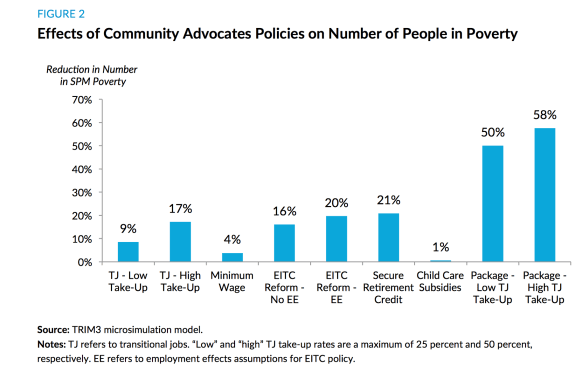
The policy package as a whole is simulated to reduce the SPM poverty rate in 2010 from 14.8 percent to 7.4 percent (or 6.3 percent with more generous take-up assumptions for transitional jobs). This represents a drop of 50 to 58 percent in the number of people in SPM poverty. The direct cost of the policy package is estimated to be $332 billion to $399 billion. These results suggest that a comprehensive policy package can have substantial antipoverty effects, even during a deep recession.
Chosen excerpts by Job Market Monitor. Read the whole story at Reducing Poverty in the United States: Results of a Microsimulation Analysis of the Community Advocates Public Policy Institute Policy Package.



 Job Market Monitor
Discussion
No comments yet.