Proximity to employment can influence a range of economic and social outcomes, from local fiscal health to the employment prospects of residents, particularly low-income and minority workers. An analysis of private-sector employment and demographic data at the census tract level reveals that:
- Between 2000 and 2012, the number of jobs within the typical commute distance for residents in a major metro area fell by 7 percent.
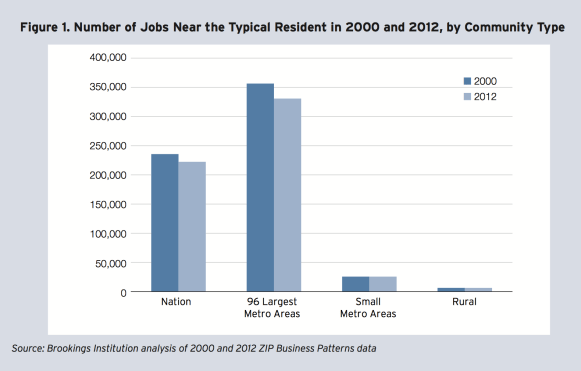
- As employment suburbanized, the number of jobs near both the typical city and suburban resident fell. Suburban residents saw the number of jobs within a typical commute distance drop by 7 percent, more than twice the decline experienced by the typical city resident (3 percent). In all, 32.7 million city residents lived in neighborhoods with declining proximity to jobs compared to 59.4 million suburban residents.
- As poor and minority residents shifted toward suburbs in the 2000s, their proximity to jobs fell more than for non-poor and white residents. The number of jobs near the typical Hispanic (-17 percent) and black (-14 percent) resident in major metro areas declined much more steeply than for white (-6 percent) residents, a pattern repeated for the typical poor (-17 percent) versus non-poor (-6 percent) resident.
- Residents of high-poverty and majority-minority neighborhoods experienced particularly pronounced declines in job proximity. Overall, 61 percent of high-poverty tracts (with poverty rates above 20 percent) and 55 percent of majority-minority neighborhoods experienced declines in job proximity between 2000 and 2012. A growing number of these tracts are in suburbs, where nearby jobs for the residents of these neighborhoods dropped at a much faster pace than for the typical suburban resident (17 and 16 percent, respectively, versus 7 percent).
Chosen excerpts by Job Market Monitor. Read the whole story at The growing distance between people and jobs in metropolitan America | Brookings Institution.



 Job Market Monitor
Discussion
Trackbacks/Pingbacks
Pingback: Communting to Work – The future does not have to be this way | Job Market Monitor - September 29, 2015