If households accept declining consumption in retirement, they need less wealth to maintain their living standard. If households consume less once their kids leave home, they have a more modest target to replace and they save more between the emptying of the nest and retirement. These two assumptions are the levers that allow one to toggle between the target replacement rate and optimal savings models.
The question is which set of assumptions is more plausible. Will people accept declining consumption in retirement or do they prefer steady real consumption? Do parents cut back on consumption when kids leave, or do they spend the slack in their budgets? No one really knows the answers. Spending does decline as people age, but it is unclear the extent to which this pattern tracks declining income; people cannot spend what they do not have. On the side of steady consumption, financial planning tools invariably assume that households require level amounts. How households react when the kids leave is also not well understood. One study found that household consumption did not decline, meaning that per-capita consumption increased after the kids left. But its sample size was small, so the effects of kids remain an unresolved issue.
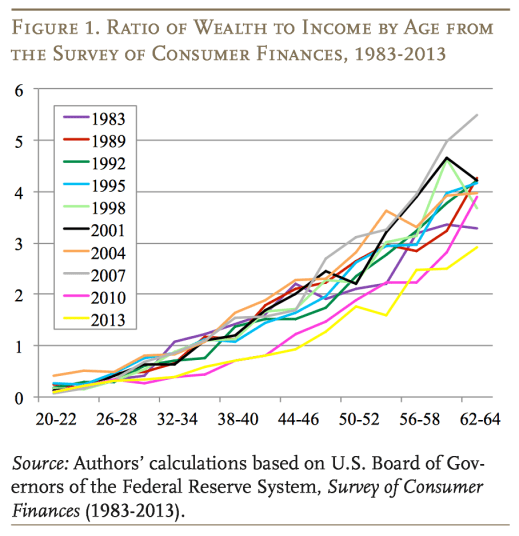
Of all the studies, perhaps the most convincing evidence about retirement preparedness is the simple calculation of wealth-to-income ratios from the Survey of Consumer Finances. These ratios have remained unchanged over time despite several developments that suggest they should have increased. Thus, we are not surprised that calculations involving target replacement rates show that about half of households will be unable to maintain their standard of living in retirement.
The brief‘s key findings are:
- Federal Reserve data show that retirement preparedness has been declining over time, but studies on the level of preparedness offer conflicting assessments.
- The National Retirement Risk Index (NRRI) finds half of households are “at risk,” while studies of optimal savings suggest less than one-tenth will fall short.
- The optimal savings results depend crucially on two assumptions:
- households spend less when their kids leave home (the NRRI assumes no decline); and
- households plan for declining consumption in retirement (the NRRI assumes steady consumption).
- While the issue remains unsettled, the Federal Reserve data are consistent with the NRRI finding that retirement shortfalls are a growing problem.
Chosen excerpts by Job Market Monitor. Read the whole story at Are Retirees Falling Short? Reconciling the Conflicting Evidence | Center for Retirement Research.



 Job Market Monitor
Discussion
Trackbacks/Pingbacks
Pingback: Saved for Retirement – How Much ? | Job Market Monitor - May 17, 2015