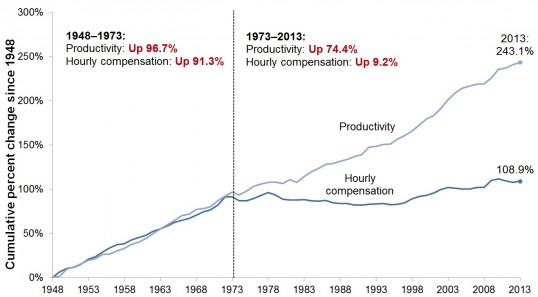
Wage stagnation for the vast majority was not created by abstract economic trends. Rather, wages were suppressed by policy choices made on behalf of those with the most income, wealth, and power. In the past few decades, the American economy generated lots of income and wealth that would have allowed substantial living standards gains for every family. The same is true looking forward: Overall income and wealth will continue to grow. The key economic policy question is whether we will adopt policies that enable everyone to participate in a shared prosperity, or whether the growth of income and wealth will continue to accrue excessively and disproportionately to the best-off 1 percent.

Chosen excerpts by Job Market Monitor. Read the whole story at Wage Stagnation in Nine Charts | Economic Policy Institute.
Related Posts
US – Why wages are not rising as job growth increases
Why wages are not growing for the vast majority of workers in the United States and what it will take to get us there. First, the trend of stagnating U.S. wage growth is nothing new. The past three decades of wage growth — save for the late-1990s boom — have given the median U.S. wage … Continue reading
US – The disconnect between productivity and wages, 1948–2013
Since 1979, hourly pay for the vast majority of American workers has diverged from economy-wide productivity, as shown in Figure D, and this divergence is at the root of numerous American economic challenges. Between 1979 and 2013, productivity grew 64.9 percent, while hourly compensation of production and nonsupervisory workers, who comprise over 80 percent of … Continue reading
Low Wages in US – About 20.6 million people (30% ) are near-minimum-wage workers
About 20.6 million people — 30% of all hourly, non-self-employed workers 18 and older — are what we call “near-minimum-wage workers,” meaning they earn more than the current minimum wage (either the federal $7.25-an-hour minimum or a higher state minimum) but less than the $10.10 hourly rate that emerged over the past year as a … Continue reading
Wages in US – Where are the raises?
After all, according to the Dallas Fed, wages should accelerate once unemployment falls below 6.1 percent. Well, the problem, as economists David Blanchflower and Adam Posen point out, is that there’s still a lot of shadow unemployment right now. That includes people who aren’t just officially jobless, but those who are either too discouraged to look … Continue reading
US – The second stretch of economic expansion in a row that has come with little to no growth in real wages
The private sector has now added 10.3 million jobs for 55 straight months, the longest streak on record. Today’s report is all but certain to show tens of thousands more jobs added in October, pushing the streak still further. But wages over that period have barely outpaced the rate of inflation, making this the second … Continue reading
Wages in US – 50% make less than $28,031 a year
The Social Security Administration has just released wage statistics for 2013, and the numbers are startling. Last year, 50 percent of all American workers made less than $28,031, and 39 percent of all American workers made less than $20,000. If you worked a full-time job at $10 an hour all year long with two weeks … Continue reading



 Job Market Monitor
Discussion
Trackbacks/Pingbacks
Pingback: Fascism - Page 22 - Defending The Truth Political Forum - December 4, 2015