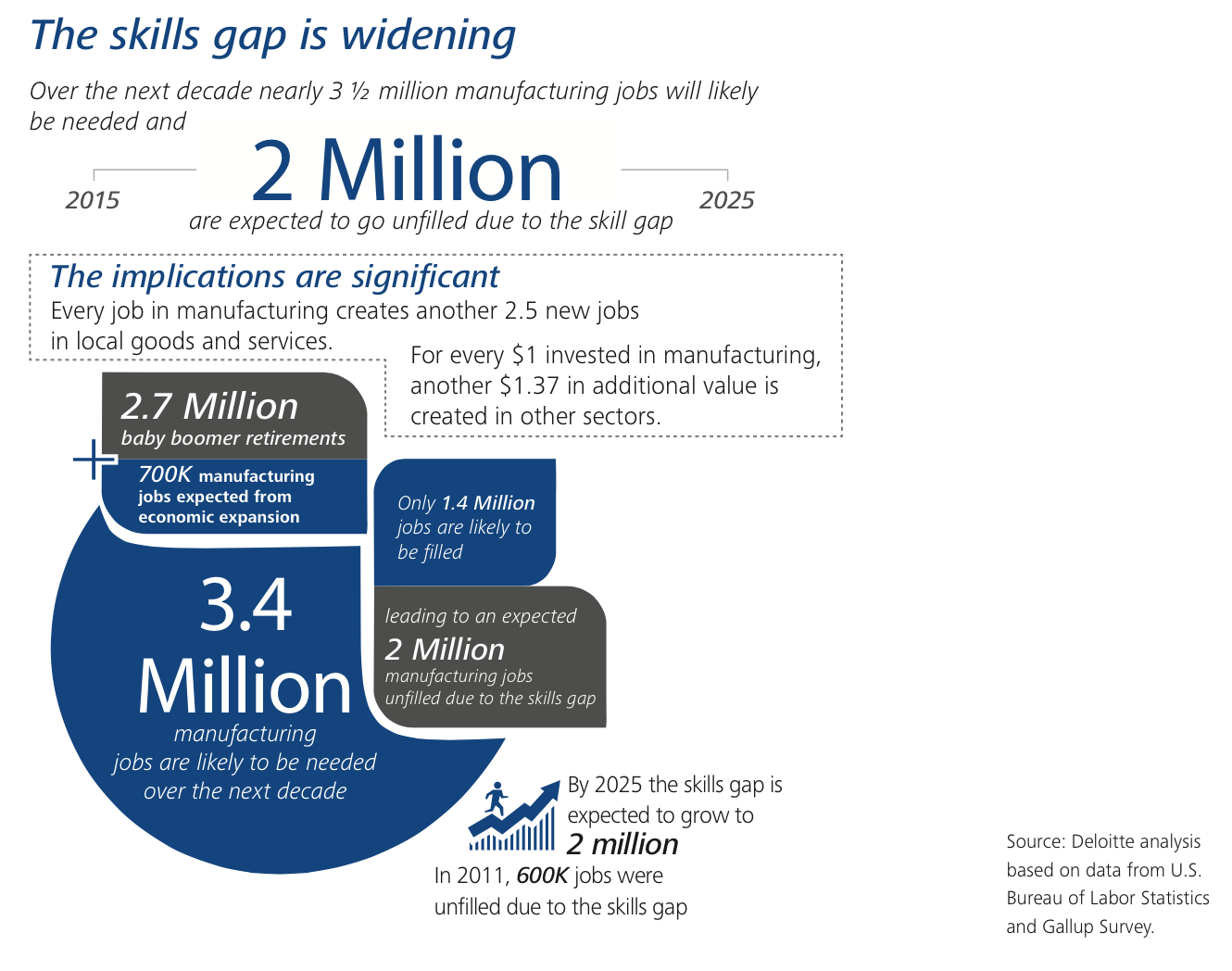
A strong manufacturing industry is fundamental to our nation’s economic prosperity. Since the industrial revolution, manufacturing has contributed to higher export potential, better standards of living, and more jobs. Investments in manufacturing have a strong multiplier effect for the broader economy, too. Every dollar spent in manufacturing adds $1.37 to the U.S. economy, and every 100 jobs in a manufacturing facility creates an additional 250 jobs in other sectors. In short, manufacturing matters.
The skills gap is widening
Over the next decade, nearly three and a half million manufacturing jobs likely need to be filled and the skills gap is expected to result in 2 million of those jobs going unfilled. There are two major contributing factors to the widening gap – baby boomer retirements and economic expansion. An estimated 2.7 million jobs are likely to be needed as a result of retirements of the existing workforce, while 700,000 jobs are likely to be created due to natural business growth. In addition to retirements and economic expansion, other factors contribute to the shortage of skilled workforce, including loss of embedded knowledge due to movement of experienced workers, a negative image of the manufacturing industry among younger generations, lack of STEM (science, technology, engineering and mathematics) skills among workers, and a gradual decline of technical education programs in public high schools.
The impact is significant
With CEOs and manufacturing executives around the world identifying talent-driven innovation as the number one determinant of competitiveness, it stands to reason the implications of such a shortage are significant and can have a material impact on manufacturers’ growth and profitability. For example, 82 percent of executives responding to the Skills gap survey indicate they believe the skills gap will impact their ability to meet customer demand, and 78 percent believe it will impact their ability to implement new technologies and increase productivity. In addition, executives indicate the skills gap also impacts the ability to provide effective customer service (69 percent), the ability to innovate and develop new products (62 percent), and the ability to expand internationally (48 percent).
Chosen excerpts by Job Market Monitor. Read the whole story at Skills Gap in Manufacturing – The Manufacturing Institute.



 Job Market Monitor
Reblogged this on Express Employment Professionals.
Posted by eeclearfield | February 28, 2015, 4:09 pm