After being displaced from their jobs, workers experience reduced earnings for many years and are at greater risks of other problems as well. The ills suffered by displaced workers motivated several recent expansions of government programs, including the unemployment insurance system, and have spurred calls for wage insurance that would provide longer-run earnings replacement. However, while the average size and the individual characteristics associated with the losses are relatively clear, the theory of displacement-induced earnings loss is scattered. Much of the policy discussion appears to interpret displacement-induced losses through the lens of specific human capital theory, in which skills are specific to jobs, locations, industries, or occupations, and that model has considerable empirical support. Assistance for displaced workers may improve well-being in that model since it insures workers against the risk that their consumption of goods and services might fall for idiosyncratic reasons and, as a consequence, allows workers to make more productive but higher-risk career choices. But there are other credible theories of costly job displacement that have different causal mechanisms, different interpretations and different policy implications. This paper reviews theories of costly job displacement and discusses their consistency with the available empirical evidence.
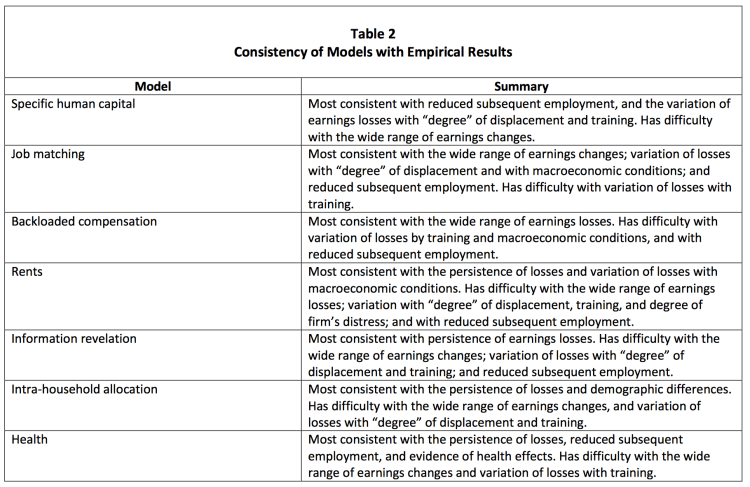
There are many studies of earnings and employment outcomes for displaced workers. In this section we review the findings of that literature with the goal of identifying empirical regularities that provide evidence for or against various theories of earnings losses from job displacement. We organize our discussion on a result-by-result basis and, after reviewing each result, outline what we perceive to be its implications for the relevance of competing theories. In particular, our review provides support for the following empirical regularities:
- Earnings losses are persistent,
- The range of earnings changes is wide,
- Earnings losses increase with “degree” of displacement,
- Earnings losses vary by amount of schooling and training,
- Earnings losses depend on macroeconomic conditions,
- Earnings losses are due in part to reduced rates of employment,
- Earnings losses vary by degree of employer distress,
- Earnings losses vary by sex, age and race, and
- Displacement harms health, particularly mental health.
We find that while specific human capital is important, we cannot rule out important roles for other theories.
Chosen excerpts by Job Market Monitor. Read the whole story at Do We Know Why Earnings Fall with Job Displacement? Working Paper: 2015-01 | Congressional Budget Office.



 Job Market Monitor
Discussion
No comments yet.