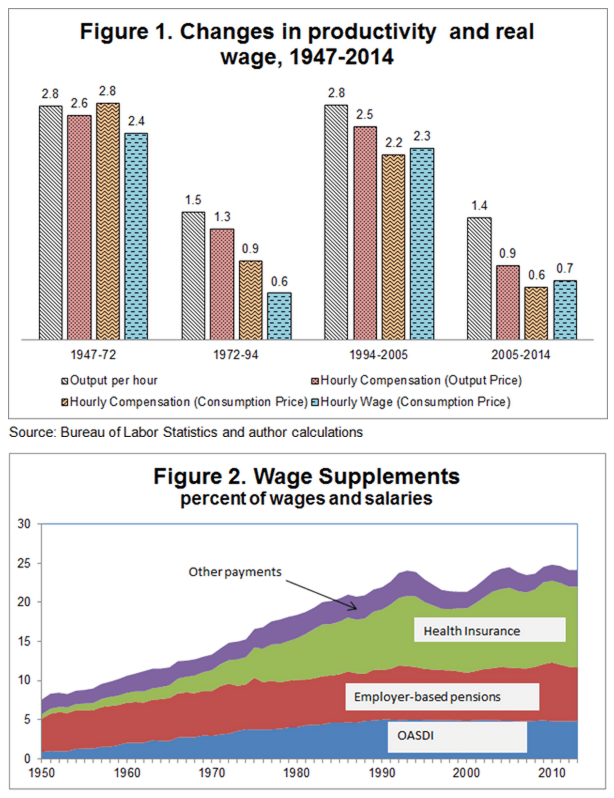
[T]he data of figure 1 clearly document a major slowdown in real wage growth. It is largely the product of poor productivity performance over the past decade, but that may not be surprising in view of the enormous economic losses that were precipitated by the financial crises. Nor is it unprecedented if the ICT revolution is viewed as a transitory phenomenon. The new phenomenon is the decline in labor’s share of income for which we have no satisfactory explanation. It may reflect the huge rents that accrued to commodity producers during the boom of the last decade, and as that comes to an end labor’s share may rise toward the historical norm. However, some analysts point to the development of a highly competitive global market for labor combined with a more general reduction in product-market competition through reliance of mergers, IT patents, and regulations that suggest a reduced labor share may be a longer-lasting phenomenon.
Finally, there has been an enormous expansion of the employment-based system used to finance the provision of retirement and health care (supplements). Those costs are often not evident to the typical worker, even though the benefits are popular. However, the costs have played a surprisingly minor role in the distinction between labor compensation and wages in recent years. In fact, the growth of take-home pay in nonfarm business, shown in figure 1, has slightly outpaced that of hourly compensation since 1995. The evolution of the non-wage benefits can be seen more clearly in figure 2, which displays the cost of the major programs and a percentage of wage and salary payments. There has been no major expansion of the basic social security program since mid-1980s, and employers are phasing out their contributions to defined benefit plans in favor of defined contribution plans that are more reliant on direct employee contributions. The big expansion has been in employment-based health insurance, but even those costs have slowed in recent years. The category of other payments includes workers’ compensation and unemployment insurance…
Chosen excerpts by Job Market Monitor. Read the whole story at Sources of Real Wage Stagnation | Brookings Institution.



 Job Market Monitor
Discussion
No comments yet.