The global talent crisis is continuing to worsen. Across the globe we are seeing organisations fighting to find employees with the necessary skills and training.
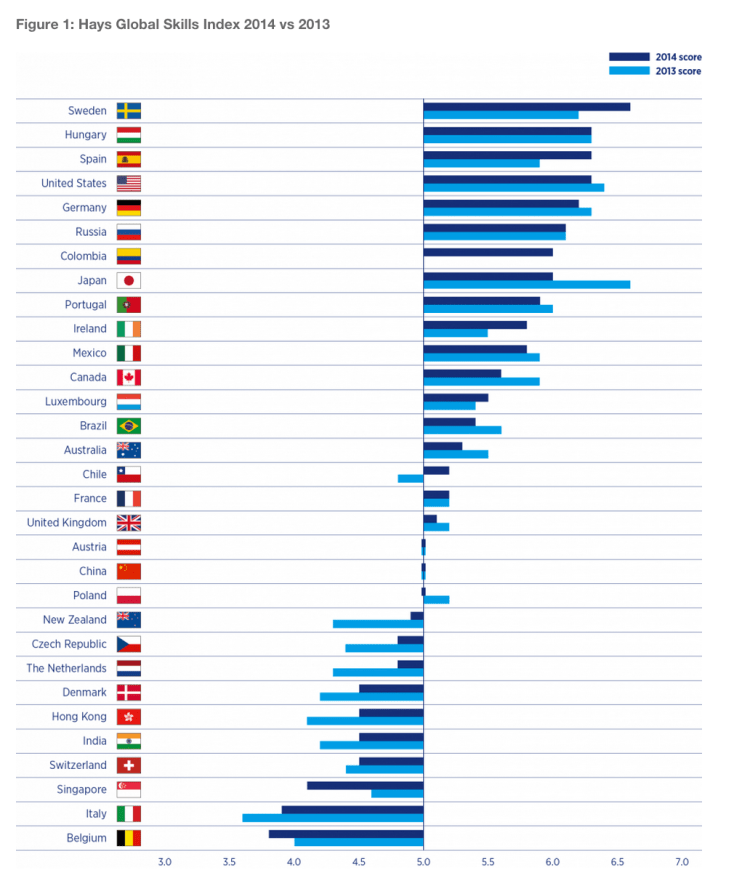
The Hays Global Skills Index 2014 reflects growing pressure in the skilled labour markets as the global economy recovers. Taken as a whole, labour market conditions tightened across the countries covered by the Index, and pressures are likely to get worse before they get better for businesses fighting for the right talent to support their growth plans.
Yet despite this, there are early indicators that labour markets are finally moving in the right direction. Among the countries where markets were particularly tight last year, conditions have generally eased modestly. At the same time conditions have generally picked up among the countries suffering too little demand for talent.
Where the Index shows labour markets becoming more stressed, a pickup in wage pressure is the primary influence. In some cases, such as Italy, this may reflect entrenched problems, such as an endemic skills mismatch. But elsewhere, emerging wage pressures may in fact be the signs that economies are on the mend.
Indeed, economic forecasters predict that virtually all of the 31 countries included in the Index will experience positive economic growth in 2014. For many economies, growth this year will be slight, but it suggests that demand for skilled labour is likely to increase across most of the countries in the Hays Global Skills Index. This will lead to existing workers being asked to work more hours, potentially higher wages in areas of greatest demand and, in time, more widespread employment.
While demand seems to be picking up, in some countries the supply-side of the market looks less benign. Firstly, many people appear to have left the labour market (as evidenced by a falling participation rate), possibly discouraged after having found it difficult during the recession years to find, or retain, a job. A second worrying trend is increasing levels of labour market regulations. While some of this new regulation may be an understandable attempt to protect jobs during an economic downturn, they may inadvertently hinder job creation as conditions pick up.
The mismatch between the skills that firms are seeking and the ones the workforce have to offer worsened in more countries than it improved. This is bad news for the unemployed and firms looking to hire and is likely to lead to many businesses struggling to fill available roles. This is also bad news for the global economy overall.
If businesses don’t have the skills they need to grow it is likely to adversely impact on overall economic growth.
Wage pressures which reflect the availability of, and demand for, labour increased in 2014. But relative to the past, wage inflation in high-skill industries and high-skill occupations does not appear abnormal relative to the rates at which wages are rising elsewhere in the economies.
The overall picture shows that global labour markets are still experiencing high levels of stress and that the associated skills mismatch is building toward a talent maelstrom. There is no easy solution to this problem but governments and businesses must work together to identify workable solutions to alleviate these issues and allow further economic prosperity.
Chosen excerpts by Job Market Monitor. Read the whole story at Introduction | Hays Global Skills Index.



 Job Market Monitor
Reblogged this on Executive Training Dubai.
Posted by Rami Kantari | December 27, 2014, 11:05 am