In 2013, the Federal Reserve Board’s Division of Consumer and Community Affairs began exploring the experiences and expectations of young Americans entering the labor market. Staff reviewed existing research and engaged external research and policy experts to identify the potential economic implications of these labor market trends on young workers.
This initial exploration raised several questions about the experiences of young workers that were not fully explained by existing data. In response, the Federal Reserve conducted a survey, the Survey of Young Workers, in December 2013 to develop a deeper understanding of the forces at play. The online survey was intended to be exploratory—ultimately confirming some insights and highlighting areas worthy of additional study. The Survey of Young Workers was administered by GfK (formerly Knowledge Networks), using its Internet panel. The 2,097 survey respondents ranged in age from 18 to 30. Details about the survey, its methodology, and limitations can be found in the body of the report and in a methodological appendix.
Key Findings
This report presents findings from the December 2013 survey. Key findings include the following:
Connecting Education and the Labor Market
Educational programs and goals should align with labor market demands in order to prepare students to join the workforce
- Students need information on potential job outcomes from a variety of educational options to
 guide their career-planning decisions. In fact, respondents noted that uncertainty about job outcomes is a barrier to enrollment in postsecondary education.
 - The current gap in alignment between education and the labor market may contribute to the number of young workers who have not found paid work in their chosen field of study. Only 42 percent of working respondents in the survey have a job that is closely related to their field of study.
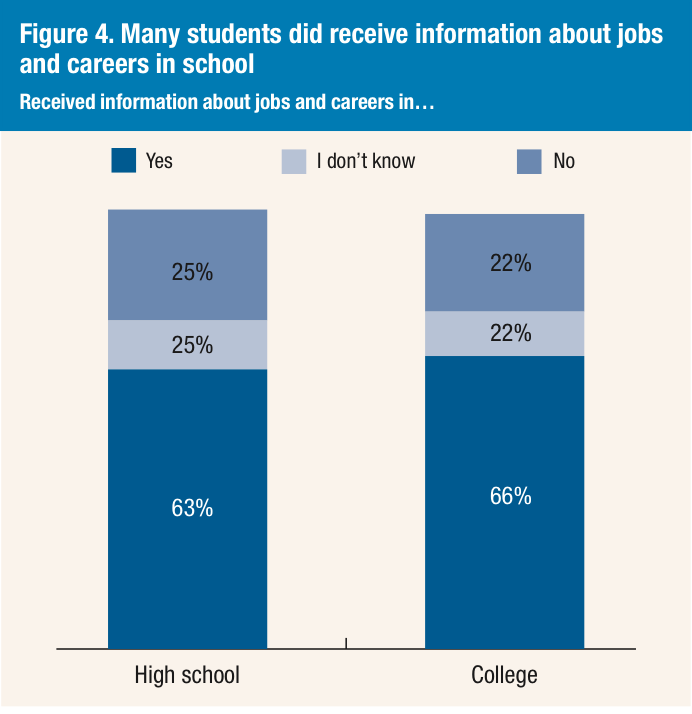
- Many high school students are not receiving adequate information about job planning. In the survey, 63 percent of respondents reported that they received information about jobs and careers during high school, while 24 percent of respondents reported that they received none.
- This situation is similar for college students. Among respondents who attended any college, 66 percent received information about jobs during these years, while 22 percent reported that they received none.
- According to survey respondents, school counselors and teachers are the primary source of job information in both high school and college. Hence, educational institutions have an opportu- nity to provide students with more information about the labor market.Young workers are responding to the labor market’s increasing demand for postsecondary credentials and degrees.
Young workers are responding to the labor market’s increasing demand for postsecondary credentials and degrees

- Thirty-seven percent of the respondents reported that they have the level of education and training needed for the type of job that they would like to hold in the next five years. As expected, the respondents’ confidence in their education increases with each level of attainment.
- In response to the need for more education, nearly one-third of the total respondents are currently enrolled in an education or training program.The labor market rewards education and work experience with career paths and higher earnings
- Respondents with higher levels of education are more likely to be employed, to be working in a field related to their education and training, and to characterize themselves as being in a “career” rather than “just a job.”
- Respondents with higher levels of education and work experience are more likely to have higher earnings and to be able to cover their monthly household expenses.
- Respondents with early work experience, such as a high school job, are more likely to be currently working and more likely to have a full-time job than those who did not work during high school.Workers with a postsecondary degree have the most opportunity for upward mobility, with 39 per- cent describing their job as a “career” and 23 per-cent reporting they have “just a job.”
Job Fit
Job satisfaction is driven by compensation and schedule
- According to the survey, 66 percent of respondents are somewhat satisfied or very satisfied with their job arrangements over the past five years. The satisfaction of these respondents is attributed to their compensation and their schedule.
- Likewise, lack of job satisfaction is driven by compensation and schedule.Despite the importance of education and work experience, intangibles still play a role in the labor marketAccording to the survey, landing a job is still heav- ily based on personal connections. Respondents identified personal networks as a primary source in their job search process.
- Demographics also play an important role in labor market outcomes. For example, non-Hispanic white respondents are more likely than other racial and ethnic groups to have early job information and experience. This subgroup was more likely to receive this information from their parents, friends and family, and their place of work. This group is also more likely to have held a job while in high school and college.
Chosen excerpts by Job Market Monitor. Read the whole story at In the Shadow of the Great Recession: Experiences and Perspectives of Young Workers



 Job Market Monitor
Discussion
No comments yet.