Every month, the Bureau of Labor Statistics releases a flood of data about employment and unemployment in the previous month. And every month, the lion’s share of the attention goes to one figure — the unemployment rate — as an indicator of where the U.S. economy stands. Today, for instance, the BLS said unemployment last month fell to 5.8%, as 683,000 more people reported finding work, which sounds like good news.
But the unemployment rate isn’t the only, or even necessarily the best, indicator to come out of the monthly jobs report. Simply being out of work isn’t enough for a person to be counted as unemployed; he or she has to have been available to work and actively looking for work, or on temporary layoff. (As the BLS itself noted once upon a time, “Being employed is an observable experience, while being unemployed often lacks that same concreteness.”) In any given month, the unemployment rate can rise or fall depending on the interplay between how many people find or lose jobs and how many join or leave the active labor force.
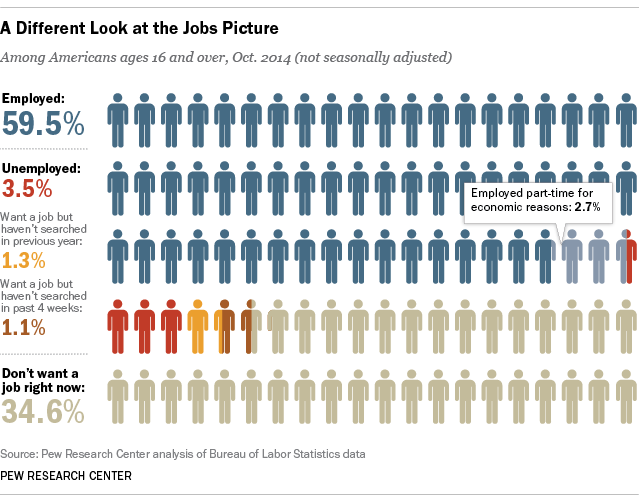
Chosen excerpts by Job Market Monitor. Read the whole story at Employment, unemployment and underemployment: Different stories from the jobs numbers | Pew Research Center.



 Job Market Monitor
Discussion
No comments yet.