In 2012, more than a quarter of university graduates in Canada aged 25 to 65 had a literacy score at the second level or below (out of five levels) in a survey on adult competencies led by the Organisation for Economic Co-operation and Development (OECD).
The survey, which was part of the OECD Programme for the International Assessment of Adult Competencies (PIAAC), assessed people’s level of proficiency in skills related to literacy, numeracy and problem solving in technology-rich environments.
In the PIAAC, lower levels of literacy indicate that individuals may be less likely to be able to integrate information across multiple sources, and may be only able to undertake tasks of limited complexity.
Lower numeracy levels indicate that individuals may be less likely to perform complex mathematical information, may be less likely to use problem solving strategies, and may be more likely to be able to only perform simple tasks.
Among all Canadians aged 25 to 65 in 2012, almost half (49%) fell in the lower range for literacy proficiency, and about 55% were in the lower range for numeracy proficiency (level 2 or below).
Less-educated individuals were more likely to have lower levels of literacy and numeracy. For instance, 88% of individuals aged 25 to 65 who did not have a high school degree had literacy in the lower range.
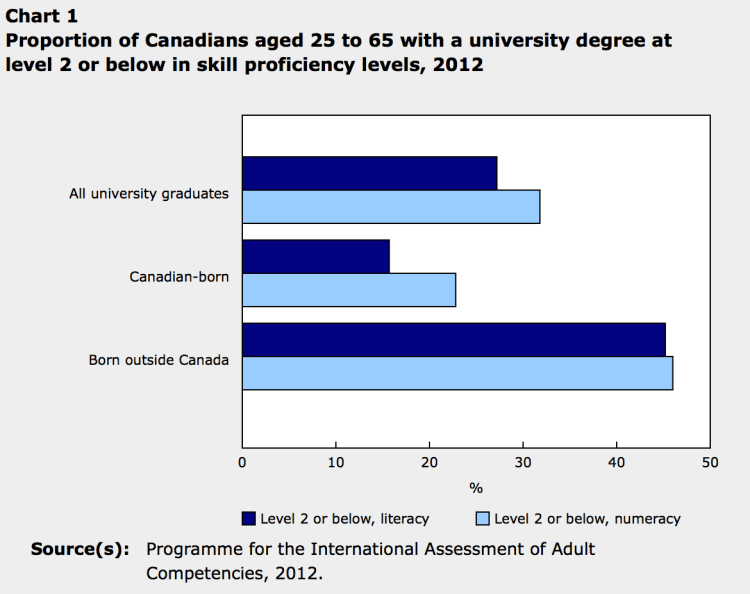
Yet, some university graduates were in the lower range of literacy and numeracy (level 2 or below). Specifically, 27% of university graduates were in the lower range for literacy in 2012 and 32% were in the lower range for numeracy.
Chosen excerpts by Job Market Monitor. Read the whole story at The Daily — Study: University graduates with lower levels of literacy and numeracy skills, 2012.



 Job Market Monitor
Discussion
No comments yet.