The best idea for an EMU-level automatic fiscal stabiliser is in my view a scheme where fiscal stimulus is provided to countries of the monetary union based on developments in their short-term unemployment.
Unemployment is an indicator whose big advantages are that it very closely follows developments in the economic cycle, it is easily understandable, and it is easily and promptly measurable.
Basic European unemployment insurance could replace the corresponding part of national schemes. The levels of the contribution and of the benefit should represent a relatively low common denominator between the rules of the various national schemes.
The scheme should clearly focus on cyclical unemployment caused by a drop in aggregate demand, as opposed to structural unemployment caused by skills mismatches, less efficient labour market institutions and the like.
For example, the basic European unemployment benefit would be paid only for the first 6 months of unemployment and the amount would represent 40% of the previous reference wage. These exact parameters would of course need to be discussed, depending on the desired macroeconomic stabilisation effect.
The eligibility conditions should not be too strict, so that also workers in short-term or part-time jobs could contribute and qualify for corresponding support. But in any case there would be clear conditionality in terms of the job-search and training effort.
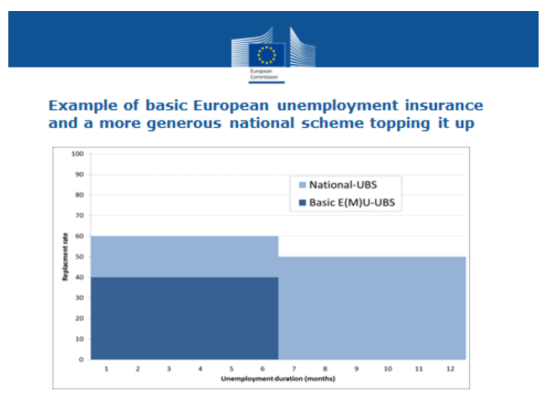
Each Member State would be free to levy an additional contribution and pay out a higher or longer unemployment benefit on top of this European unemployment insurance. What the European scheme would do is to ensure a fairly basic standard of support during short-term unemployment.
Citizens would directly benefit from EU solidarity at times of hardship, and Member States would be required to upgrade their employment services and labour market institutions to the best EU standards.
The jobseekers would continue to interact with national authorities (public employment services). However, every month these national authorities would send to the European fund the basic contribution from all their employed workers.
Likewise, every month the European fund would pay to the national authorities an amount corresponding to the sum of all the basic European unemployment benefit payments to be made that month in the country.
In principle, each country would therefore make every month an overall contribution and receive an overall payment from the European scheme. In practice, these two could of course be offset and only the net balance would be paid.
The overall volume of such a basic European unemployment insurance scheme would be around 1% of GDP, mainly depending on the exact parameters such as duration and level of the benefit or the eligibility conditions. Of course, the net transfers from or into any particular country would be smaller, because drawdowns would be offset by contributions and vice versa.
 Chosen excerpts by Job Market Monitor. Read the whole story at EUROPA – COMMUNIQUES DE PRESSE – Communiqué de presse – Basic European unemployment insurance: Countering divergences within the Economic and Monetary Union.
Related Posts
European Unemployment Insurance / Where is it going?
The concept of such an insurance could help countries in crisis as it would absorb some of the costs of a sudden and deep recession Continue reading
An EU wide unemployment insurance system?
One of the most promising measure normally present in monetary unions is unemployment compensation. This idea is currently being given a push in the EU – including by the Employment Commissioner Laszlo Andor who has talked about it as serving as an automatic stabiliser and argued that “We need and must study the possible set-up … Continue reading



 Job Market Monitor
Discussion
Trackbacks/Pingbacks
Pingback: Europe – Try the improved European Unemployment Insurance scheme simulator | Job Market Monitor - October 1, 2014
Pingback: The implementation of a European unemployment insurance – A report | Job Market Monitor - February 19, 2016
Pingback: COVID and Unemployment Insurance in US – How to make it work for all | Job Market Monitor - April 15, 2020
Pingback: Unemployment Insurance (UI) – Lessons from the American federal‐state system | Job Market Monitor - January 15, 2021