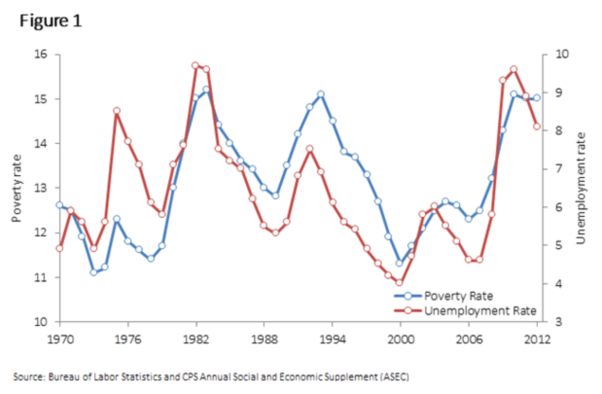
Historically, the poverty rate has moved with the unemployment rate. Since 1970, in fact, the official poverty rate has spiked during each recession. Intuitively, this makes sense—if you lose your job, then you lose access to a steady stream of income. When you find a new job—as people are wont to do in the recovery after a recession, your prospects improve. Nevertheless, as shown in Figure 1, despite the sharp decline in unemployment following the Great Recession, the headline poverty rate has remained at or near 15%.
Chosen excerpts by Job Market Monitor. Read the whole story at Poverty: It’s More than a Job Market Story | Brookings Institution.



 Job Market Monitor
Discussion
Trackbacks/Pingbacks
Pingback: Poverty in the United States in 2013 – A Congressional Research Service (CRS) Report | Job Market Monitor - October 3, 2014