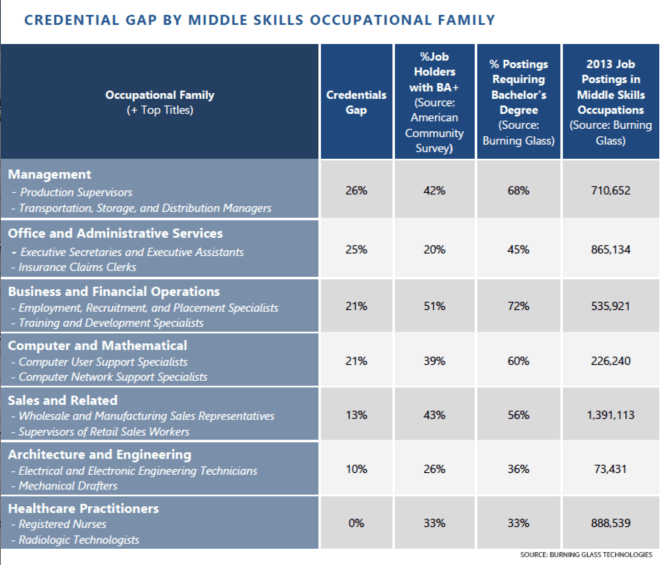
An increasing number of job seekers face being shut out of middle-skill, middle-class occupations by employers’ rising demand for a bachelor’s degree. This credential inflation, or “upcredentialing” is affecting a wide range of jobs from executive assistants to construction supervisors and has serious implications both for workers not seeking a college degree and for employers struggling to fill jobs.
Key Findings
- Employers now require bachelor’s degrees for a wide range of jobs, but the shift has been dramatic for some of the occupations historically dominated by workers without a college degree. The credential gap can amount to 25 percentage points or more for middle skill jobs in some occupational families, like Office and Administrative and Business and Financial Operations. For example, 65% of postings for Executive Secretaries and Executive Assistants now call for a bachelor’s degree. Only 19% of those currently employed in these roles have a B.A.
- In some roles, employers prefer bachelor’s credentials even when that makes the position harder to fill. For example, Construction Supervisor positions that require a B.A. take 61 days to fill on average, compared to 28 days for postings that don’t require a bachelor’s degree.
- In other occupations, such as entry level IT help desk positions, the skill sets indicated in job postings don’t include skills typically taught at the bachelor’s level, and there is little difference in skill requirements for jobs requiring a college degree from those that do not. Yet the preference for a bachelor’s degree has increased. This suggests that employers may be relying on a B.A. as a broad recruitment filter that may or may not correspond to specific capabilities needed to do the job.
- Jobs resist credential inflation when there are good alternatives for identifying skill proficiency. Many health care and engineering technician jobs, such as Respiratory Therapists, show little sign of upcredentialing. That is likely because those positions are governed by strict licensing or certification standards, well-developed training programs, or by measurable skill standards such that employers do not need to look at a college degree as a proxy for capability.
Chosen excerpts by Job Market Monitor. Read the whole story at Moving the Goalposts: How Demand for a Bachelor’s Degree Is Reshaping the Workforce.
Related Posts
Overeducation in US – 66% of workers remaining overeducated after one year research finds
In their paper The career prospects of overeducated Americans, (Preliminary version) @ unc.edu Brian Clark, Clément Joubert and Arnaud Maurel analyze career dynamics for the substantial share of U.S. workers who are deemed overeducated in the literature. They use data from the National Longitudinal Survey of Youth 1979 combined with the pooled 1989-1991 waves of the … Continue reading
US – Employability makes unemployment to trickles down to lower-skilled workers research finds
Unemployment “trickles down” to America’s poorest and most vulnerable because, during recessions, higher-income workers with more education take jobs that are below their qualification level, according to new research. Such underemployment, in turn, leaves fewer job openings for which the so-called lower-skilled workers are qualified. “Some high-skill workers move down the occupational ladder in order … Continue reading
US / Almost half of employed college graduates are in jobs requiring less than college education
“Political leaders, prominent foundations, and college presidents have argued that the nation must increase the proportion of adults with college degrees in order for America to remain competitive in the global economy” write Richard Vedder, Christopher Denhart, and Jonathan Robe in Why Are Recent College Graduates Underemployed? University Enrollments and Labor-Market Realities (Adapted quotes to follow). Supporting those … Continue reading
US – 74 percent of STEM grads are not employed in STEM occupations finds Census Bureau
The U.S. Census Bureau reported today that 74 percent of those who have a bachelor’s degree in science, technology, engineering and math — commonly referred to as STEM — are not employed in STEM occupations. In addition, men continue to be overrepresented in STEM, especially in computer and engineering occupations. About 86 percent of engineers … Continue reading
US – Of 4 million job openings posted online, 2 million are for college graduates New Georgetown report finds
More than 80 percent of job openings for workers with a bachelor’s degree or better are posted online, compared to less than 50 percent of job openings for workers with less education*, according to a new report from the Georgetown University Center on Education and the Workforce. The report analyzes the demand for college talent … Continue reading
US – The underemployment of college graduates is displacing lower skilled workers
The jobless rate of Americans ages 25 to 34 who have only completed high school grew 4.3 percentage points to 10.6 percent in 2013 from 2007, according to Bureau of Labor Statistics data. Unemployment for those in that age group with a college degree rose 1.5 percentage points to 3.7 percent in the same period. … Continue reading



 Job Market Monitor
Discussion
Trackbacks/Pingbacks
Pingback: The economic recovery is historically terrible for the middle class – The Washington Post | Job Market Monitor - September 18, 2014
Pingback: Underemployment – A negative impact on future pay research finds | Job Market Monitor - March 31, 2016
Pingback: Skills and Credential Chaos in US – New reports find nearly one million credentials and $2t in yearly education and training expenditures | Job Market Monitor - March 1, 2021
Pingback: Skills and Credential Chaos in US – New reports find nearly one million credentials and $2t in yearly education and training expenditures | Job Market Monitor - March 1, 2021
Pingback: Alternative Credentials in Higher Ed in US – Ninety-four percent of respondents’ institutions offer alternative credentials | Job Market Monitor - March 10, 2024