Six years after the financial panic that nearly sank the U.S. economy, it’s the millions of Americans who aren’t working, or working less than they want to, who pose a challenge to policymakers and a are major contributor to Americans’ persistently sour feeling about the economy.
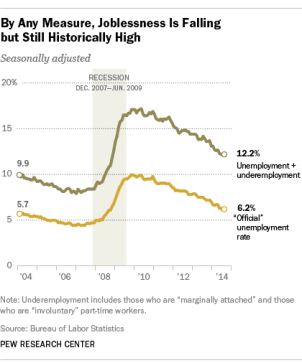
Although the official unemployment rate was down to 6.2% in July (figures from August are due out Sept. 5), many economists and other analysts have concluded that that measure doesn’t fully capture what’s happened to the U.S. economy since the Great Recession officially ended in the summer of 2009. An alternate measure, dubbed U-6 by the Bureau of Labor Statistics, adds two more groups to the officially unemployed: people who are considered “marginally attached” to the labor force, in that they want and are available to work but haven’t looked for a job recently, and people working part-time for economic reasons rather than by their own choice (also called “involuntary” part-time workers).
Including those two groups, labor economists say, produces a more comprehensive measure of “labor underutilization,” or underemployment. The U-6 measure was at 12.2% in July — 6 full percentage points higher than the official unemployment rate.
Chosen excerpts by Job Market Monitor. Read the whole story at For Labor Day, a look at the state of underemployment | Pew Research Center.



 Job Market Monitor
Discussion
No comments yet.