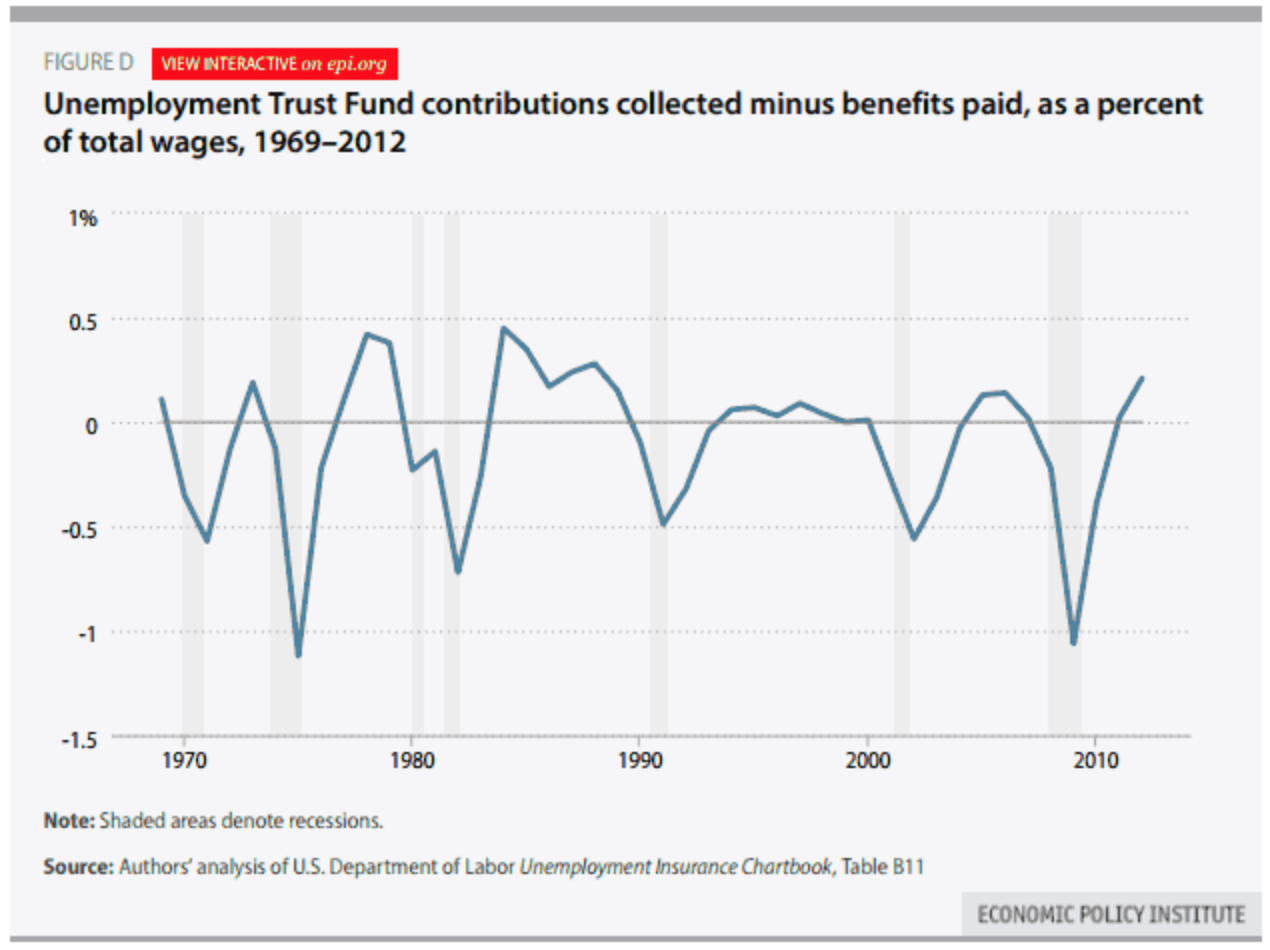
Most state unemployment insurance fund accounts became insolvent in the wake of the Great Recession because states did not adequately fund them in the early to mid-2000s recovery. States that responded to the insolvency by cutting the duration of unemployment benefits did not save significant amounts of money or boost employment. There are no clear differences between the financial positions or labor market outcomes of states whose UTF accounts became insolvent and cut the duration of benefits relative to states with insolvent accounts that did not cut benefits. But the benefit-cutting states did share some things in common: an overall lack of support for social programs that predates the Great Recession, and fiscal policies that feature low per capita state spending and tax collection. In short, states that decided to cut the available duration of jobless benefits appear to have made a political decision more than a fiscal one.
Some claim that extended unemployment benefits are to blame for extended high unemployment. But the effect of UI changes on the labor market is one of the most-studied topics in empirical economics, and the overall conclusion of the research literature reviewed in this report is that there is little evidence that extending unemployment aid provides a disincentive to work that is large enough to materially change the trajectory of key labor market aggregates. Rather, our review finds that the cause of the persistent problem of a depressed number of workforce participants relative to the overall population is that employers’ demand for workers remains weak, not that workers have effectively chosen to stay unemployed to get benefits.

This finding has largely been reinforced by the examination of UI and labor market outcomes during and after the Great Recession, including at the state level. And yet several states chose to cut the duration of jobless benefits in recent years. We find that the track record of the UI system over the last decade strongly argues against such cuts, and for policy measures that could better ensure that the UI system serves its countercyclical role of boosting spending in times when demand drops. Such measures could be pursued by states doing a better job of prefunding UI trust fund accounts during economic expansions as well as by federal lawmakers substantially increasing the federal commitment to the UI system.
via State Cuts to Jobless Benefits Did Not Help Workers or Taxpayers | Economic Policy Institute.



 Job Market Monitor
Discussion
No comments yet.