Since 2000 all of the net gain in the number of working-age (16 to 65) people holding a job has gone to immigrants (legal and illegal). This is remarkable given that native-born Americans accounted for two-thirds of the growth in the total working-age population. Though there has been some recovery from the Great Recession, there were still fewer working-age natives holding a job in the first quarter of 2014 than in 2000, while the number of immigrants with a job was 5.7 million above the 2000 level. 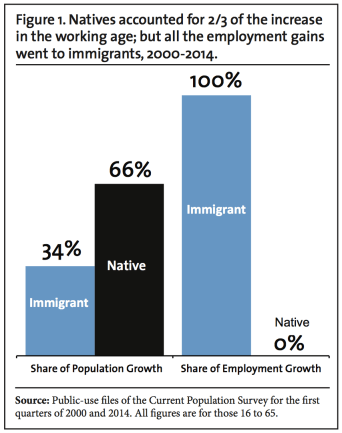
All of the net increase in employment went to immigrants in the last 14 years partly because, even before the Great Recession, immigrants were gaining a disproportionate share of jobs relative to their share of population growth. In addition, natives’ losses were somewhat greater during the recession and immigrants have recovered more quickly from it. With 58 million working-age natives not working, the Schumer-Rubio bill (S.744) and similar House measures that would substantially increase the number of foreign workers allowed in the country seem out of touch with the realities of the U.S. labor market.
Three conclusions can be drawn from this analysis:
- First, the long-term decline in the employment for natives across age and education levels is a clear in- dication that there is no general labor shortage, which is a primary justification for the large increases in immigration (skilled and unskilled) in the Schumer-Rubio bill and similar House proposals.
- Second, the decline in work among the native-born over the last 14 years of high immigration is consis- tent with research showing that immigration reduces employment for natives.
- Third, the trends since 2000 challenge the argument that immigration on balance increases job oppor- tunities for natives. Over 17 million immigrants arrived in the country in the last 14 years, yet native employment has deteriorated significantly.Among the findings:
- The total number of working-age (16 to 65) immigrants (legal and illegal) holding a job increased 5.7 million from the first quarter of 2000 to the first quarter of 2014, while declining 127,000 for natives.
- In the first quarter of 2000, there were 114.8 million working-age natives holding a job; in the first quarter of 2014 it was 114.7 million.
- Because the native-born population grew significantly, but the number working actually fell, there were 17 million more working-age natives not working in the first quarter of 2014 than in 2000.
- Immigrants have made gains across the labor market, including lower-skilled jobs such as maintenance, construction, and food service; middle-skilled jobs like office support and health care support; and high- er-skilled jobs, including management, computers, and health care practitioners.
Chosen excerpts by Job Market Monitor. Read the whole story at All Employment Growth Since 2000 Went to Immigrants / Number of U.S. Born Not Working Grew by 17 Million – Center for Immigration Studies.
Related Posts
US in Maps – The biggest immigrant groups by state
The data used to create the map are from the Department of Homeland Security. In 2012, slightly more than 1 million people were granted legal permanent resident status in the U.S. (Legal permanent residents may also be referred to as “permanent resident aliens” or “green card holders.”) About 15 percent of these new immigrants are … Continue reading
US in Maps – The most popular languages by state
One of the most interesting data sets for aspiring mapmakers is the Census Bureau’s American Community Survey. Among other things, that survey includes a detailed look at the languages spoken in American homes. All the maps below are based on the responses to this survey. For instance, Mandarin, Cantonese, and other Chinese dialects are separated … Continue reading
US – The end of the “age pyramid”
The “age pyramid.” Each bar represents a five year age cohort; with those ages 0-4 on the bottom and those ages 85 and older on the top. In every society since the start of history, whenever you broke down any population this way, you’d always get a pyramid. But from 1960 to 2060, our pyramid … Continue reading
The Demography of Largest Countries 2010–50 in a Figure
Source: THE UNITED STATES AFTER THE GREAT RECESSION: THE CHALLENGE OF SUSTAINABLE GROWTH



 Job Market Monitor
Discussion
No comments yet.