The number of people performing low-skill, low-pay, manual labor tasks has grown along with the number undertaking high-skill, high-pay, nonroutine, principally problem-solving jobs.
Employment in the United States is becoming increasingly polar- ized, growing ever more con- centrated in the highest- and lowest-paying occupations and creating growing income inequality. The causes and consequences of this trend are often considered in the context of what has been a relatively “jobless” recovery from the Great Recession.
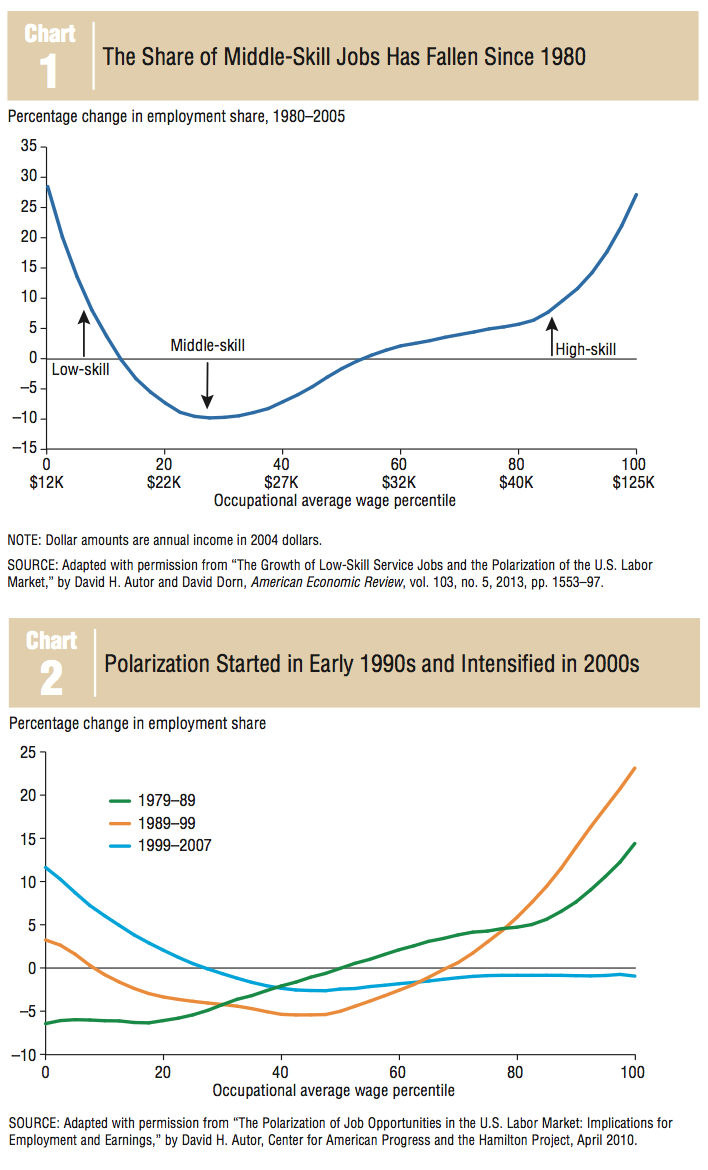
Market changes involving middle-skill jobs in the U.S. are hastening labor market polarization. The distribution of jobs by skill level has shifted dramatically since 1980 (Chart 1). The number of jobs requiring medium levels of skill has shrunk, while the number at both ends of the distribution—those requiring high and low skill levels—has expanded.
This declining prominence of middle-skill jobs is not driven by changes in labor market institutions, such as declining unionization. Rather, an increase in automation of routine tasks, a relative scarcity of skilled workers and to a lesser extent, relocation of jobs outside the country have led to the relative expansion of two kinds of jobs in the U.S. The number of people performing low-skill, low-pay, manual labor tasks has grown along with the num- ber undertaking high-skill, high-pay, nonroutine, principally problem-solving jobs.
These changes have been relatively abrupt, with losses in routine employment concentrated in the recessions of 1990–91, 2001 and especially 2008–09. Unlike with earlier downturns, middle-skill jobs were not recovered in the expansions that fol- lowed these contractions.
Start of Polarization
The rise in the shares of high-skill and low-skill jobs became evident about two decades ago (Chart 2). The U.S. labor market did not experience much polarization in the 1980s: Low-skill jobs were replaced by high-skill jobs, while the number of middle-skill jobs remained largely unchanged. Instead, polarization began about 25 years ago, in the early 1990s, and intensified in the last decade.
Chosen excerpts by Job Market Monitor. Read the whole story at Middle-Skill Jobs Lost in U.S. Labor Market Polarization
Related Posts
The decline of middle-class workers / Job polarisation and wages
Employment in traditional middle-class jobs has fallen sharply over the last few decades. At the same time, middle-class wages have been stagnant. This column reviews recent research on job polarisation and presents a new study that explicitly links job polarisation with the changes in workers’ wages. Job polarisation has a substantial negative effect on middle-skill … Continue reading
Alberta / Job growth polarized
Alberta – the economic powerhouse of the country – also shed nearly 12,000 jobs last month. But trends are built over several months, and December’s loss comes on the heels of five consecutive months of gains in Alberta. Even counting the big drop last month, the province saw a net gain of nearly 71,000 jobs … Continue reading
US Skills Gap / The Labor Market Polarization
the decline in the share of workers in middle-skill jobs is due both to a decline in inflows into these jobs and because of a rise in outflows from these jobs research finds Continue reading
The U.S. workplace is polarizing between the education haves and have-nots
The U.S. workplace is polarizing between the education haves and have-nots, says David Autor, professor of economics at Massachusetts Institute of Technology in Cambridge. So-called middle-skill jobs, typically well-paying work that doesn’t require extensive higher education, are vanishing, dividing the labor force into high- and low-skill positions. While women are moving up the knowledge ladder, … Continue reading
US – The Skills Gap
We could think of the US labor markets as consisting of two distinct pools of workers: skilled and unskilled. And while the unskilled workers are leaving the labor force, the skilled labor market is starting to tighten. Thats part of the reason for the persistent mismatch between job openings and the unemployment/marginal employment rate – … Continue reading
Skills Gap in US Manufacturing – 75 percent of manufacturers surveyed report a moderate to severe shortage of skilled resources
A new Accenture manufacturing and skills study, completed in collaboration with The Manufacturing Institute, looks at the skills shortage in the US manufacturing industry and what actions manufacturing companies can take to address this impediment to growth. Our study includes survey responses from more than 300 executives from a diverse range of US manufacturing companies. … Continue reading
Middle-Skill Jobs in US – Lobs lost in the last recession have not returned says New York Fed Pres.
Millions of U.S. teaching, construction and other middle-skill jobs lost in the last recession have not returned, exacerbating the already high unemployment that has been a drag on the U.S. recovery, New York Federal Reserve officials said on Wednesday. These middle-skill jobs, which pay roughly $25,000 to $50,000 annually, suffered the heaviest losses in the … Continue reading
The American Middle Class – No Longer the World’s Richest , Canada now higher finds NYT
The American middle class, long the most affluent in the world, has lost that distinction. While the wealthiest Americans are outpacing many of their global peers, a New York Times analysis shows that across the lower- and middle-income tiers, citizens of other advanced countries have received considerably larger raises over the last three decades. After-tax … Continue reading
US – What happened to the middle class? (Infographic)
The increased wealth of highly skilled workers, the insane wealth of those with capital, and the outsourcing of lower skilled jobs have left us all asking, “what happened to the middle class?” Source: BestMSWPrograms.com Related articles The decline of middle-class workers / Job polarisation and wages Skills Gap – Middle-skill Workers – New England: … Continue reading




 Job Market Monitor
Exceptionally exciting piece of writing
Posted by Dylan Hall | July 31, 2014, 12:16 amI hardly ever comment on these articles, but I
thought this on deserved a thumb up
Posted by Gabriel Rivera | August 6, 2014, 3:40 pm