Employment in traditional middle-class jobs has fallen sharply over the last few decades. At the same time, middle-class wages have been stagnant. This column reviews recent research on job polarisation and presents a new study that explicitly links job polarisation with the changes in workers’ wages. Job polarisation has a substantial negative effect on middle-skill workers.
Job polarisation and its cause
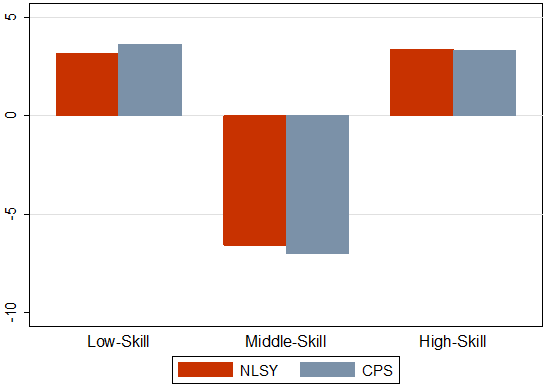
Pioneering research by Autor, Katz, and Kearney (2006), Goos and Manning (2007), and Goos, Manning, and Salomons (2009) found that the share of employment in occupations in the middle of the skill distribution has declined rapidly in the US and Europe. At the same time the share of employment at the upper and lower ends of the occupational skill distribution has increased substantially. Goos and Manning termed this phenomenon “job polarisation” and it is depicted for US workers in Figure 1.
Chosen excerpts by Job Market Monitor. Read the whole story at Job polarisation and the decline of middle-class workers’ wages | vox.
Related articles
- Computers could replace about 47 percent of jobs research finds
- The labor market implications of technological change in US
- US / Half of all STEM jobs are available to workers without a four-year college degree finds Brookings Institute
- US / 25% of all new jobs since 2010 fall in the mid-wage range, 46% in the low
- US / Long- term unemployment spans all industries, education levels, age groups, and among blue- and white-collar workers




 Job Market Monitor
Discussion
Trackbacks/Pingbacks
Pingback: The American Middle Class – No Longer the World’s Richest , Canada now higher finds NYT | Job Market Monitor - April 22, 2014
Pingback: Polarization in US – The declining prominence of middle-skill jobs | Job Market Monitor - June 10, 2014