Higher education is one of the most important investments that people make, and most students make this investment because they want a better chance to land a good career and higher earnings. But as they enter the labor market, some graduates earn far more than others. Prospective students need sound information about where their educational choices are likely to lead.
Based on information from five states (Arkansas, Colorado, Tennessee, Texas, and Virginia) that have shared earnings data with College Measures, this report shows that several factors influence earnings:
- Some short-term, higher education credentials are worth as much as long-term ones. Short-term (or “subbaccalaureate”) credentials include associate’s degrees and occupationally oriented certificates, and many who hold them will out-earn graduates with bachelor’s degrees.
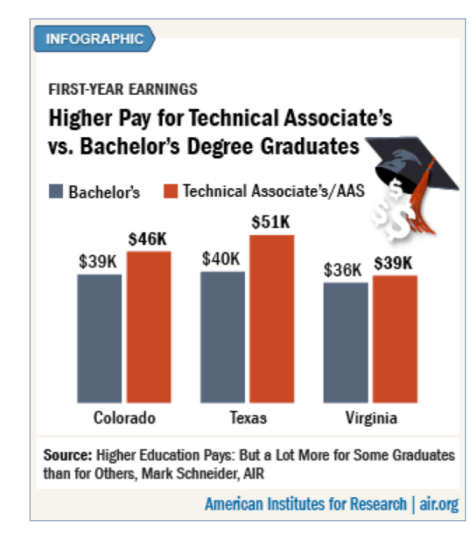
- Where you study affects earnings—but less than usually thought. Earnings vary widely among first-year graduates in different states. Further, each state has schools whose graduates fall far below their peers in terms of earnings, and, conversely, each state hosts institutions whose graduates outperform their peers from other schools.
- What you study matters more than where you study. The labor market rewards technical and occupational skills at the associate’s, bachelor’s, and master’s level. Graduates with bachelor’s degrees in music, photography, philosophy, and other liberal arts almost always earn the least among the major fields of study. Graduates with engineering degrees earned the most in every state. Graduates with degrees in health-related fields, especially nursing, are among the highest paid and are usually followed by graduates with business degrees.

- The S in STEM (Science, Technology, Engineering, and Mathematics) is oversold. Data from College Measures show that employers are paying more—often far more—for degrees in the fields of technology, engineering, and mathematics (TEM). Evidence does not suggest that graduates with degrees in Biology earn a wage premium—in fact, they often earn less than English majors.
Chosen excerpts by Job Market Monitor. Read the whole story at

Related Posts
Higher education job growth continues to outpace overall job growth in US, but the gap is narrowing
Key findings from the report for Q1 2012: Although the growth rate of higher education jobs continued to outpace the growth rate for all U.S. jobs in Q1 2012, the gap has narrowed and the “market share” of higher education jobs was unchanged year-over-year. The number of advertisements for job openings in higher education continued … Continue reading »
The combination of high education and high-skill occupation is associated with the greatest degree of skill maintenance study finds
The combination of high education and high-skill occupation is associated with the greatest degree of skill maintenance. High initial education is associated with significantly higher problem-solving skills for younger people, but this does not remain true through the life course Continue reading »
US / Theater and Arts College Grads land jobs ahead of tech grads
US – Recent graduates with tech degrees face higher unemployment rates after the Great RecessionContinue reading »
Over-educated / In 1970, only one in 100 taxi drivers and chauffeurs in the US had a college degree, today 15
In 1970, only one in 100 taxi drivers and chauffeurs in the US had a college degree, according to an analysis of labour statistics by Ohio University’s Richard Vedder, Christopher Denhart and Jonathan Robe. Today, 15 out of 100 do. Continue reading »
Times Higher Education World University Rankings 2013-2014
The Times Higher Education World University Rankings 2013-2014 judge world class universities across their core missions – teaching, research, knowledge transfer and international outlookContinue reading »
US / With over $1 trillion in outstanding student loans, it is time for higher education to be innovative
The largest bank in the United States will stop making student loans in a few weeks. JPMorgan Chase has sent a memorandum to colleges notifying them that the bank will stop making new student loans in October, according to Reuters. The official reason is quite bland. “We just don’t see this as a market that … Continue reading »
US / 38 percent adult workers with at least bach degree did work at home
http://www.bls.gov/news.release/archives/atus_06202013.htm Continue reading »



 Job Market Monitor
Discussion
Trackbacks/Pingbacks
Pingback: UK / Almost half of graduates work in non-graduate jobs, says ONS | Job Market Monitor - November 22, 2013
Pingback: US / Young college graduates are outperforming their peers with less education | Job Market Monitor - February 11, 2014
Pingback: Higher Education in US – The employment status of instructional staff members in 2 charts | Job Market Monitor - April 8, 2014
Pingback: US – Liberal arts field can and does lead to successful and remunerative careers in a wide array of professions says a report | Job Market Monitor - April 12, 2014