Its corporate tax rate, at 15%, is less than half the U.S. rate. Its debt is 35% of GDP, instead of the U.S. rate of 73%. But where Canada really shines in comparison to the United States is in its immigration policy.
Consider the simplicity of the Canadian immigration system. To enter Canada through its federal skilled worker program, applicants are ranked on a points system. One hundred points are possible, and 67 are required to get an entry visa. Included are English and French language skills (28 possible points), education (25 points), experience (15 points), adaptability (10 points), age (12 points), and job offers (10 points).
In contrast, U.S. H-1B temporary visas for new skilled immigrant workers, limited at 85,000 annually, do not meet demand. Acquiring permanent residency (a “green card”) is a lengthy and potentially costly process. Talented immigrants, such as the 51% of engineering doctorate earners and the 41% of physical sciences doctorate earners who are foreign-born, are frequently forced to leave the United States. Many come to Canada.
H-1B visa applications can be filed on April 1 of each year. In 2013, the cap was reached within the first week of the filing period. In 1999, Congress temporarily raised the quota to 115,000, and again to 195,000 in 2001, a number that did not exceed demand, but the quota reverted to 65,000 (plus 20,000 awarded for recipients of U.S. advanced degrees) in 2004.
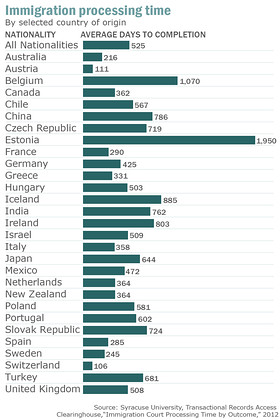
Chosen excerpts by Job Market Monitor. Read the whole story at

via In immigration, U.S. loses out to Canada – Diana Furchtgott-Roth – MarketWatch.



 Job Market Monitor
Discussion
No comments yet.