Nearly three-quarters (73 percent) of enrollments in America’s major public benefits programs are from working families. But many of them work in jobs that pay wages so low that their pay checks do not generate enough income to provide for life’s basic necessities. Low wages paid by employers in the fast-food industry create especially acute problems for the families of workers in this industry. Median pay for core front-line fast-food jobs is $8.69 an hour, with many jobs paying at or near the minimum wage.
Benefits are also scarce for front-line fast-food workers; an estimated 87 percent do not receive health benefits through their employer. The combination of low wages and benefits, often coupled with part-time employment, means that many of the families of fast-food workers must rely on taxpayer-funded safety net programs to make ends meet.
This report estimates the public cost of low-wage jobs in the fast-food industry. Medicaid, the Earned Income Tax Credit and the other public benefits programs discussed in this report provide a vital support system for millions of Americans working in the United States’ service industries, including fast food. We analyze public program utilization by working families and estimate total average annual public benefit expenditures on the families of front-line fast-food workers for the years 2007–2011.1 For this analysis we focus on jobs held by core, front-line fast-food workers, defined as nonmanagerial workers who work atleast 11 hours per week for 27 or more weeks per year.
Main Findings
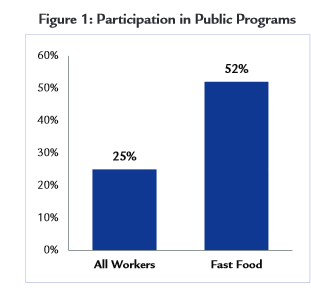
- More than half (52 percent) of the families of front-line fast-food workers are enrolled in one or more public programs, compared to 25 percent of the workforce as a whole.
- The cost of public assistance to families of workers in the fast-food industry is nearly $7 billion per year.
- At an average of $3.9 billion per year, spending on Medicaid and the Children\’s Health Insurance Program (CHIP) accounts for more than half of these costs.
- Due to low earnings, fast-food workers\’ families also receive an annual average of $1.04 billion in food stamp benefits and $1.91 billion in Earned Income Tax Credit payments.
- People working in fast-food jobs are more likely to live in or near poverty. One in five families with a member holding a fast-food job has an income below the poverty line, and 43 percent have an income two times the federal poverty level or less.
- Even full-time hours are not enough to compensate for low wages. The families of more than half of the fast-food workers employed 40 or more hours per week are enrolled in public assistance programs.
Chosen excerpts by Job Market Monitor. Read the whole story at

via Fast Food, Poverty Wages: The Public Cost of Low-Wage Jobs in the Fast-Food Industry.
Related Posts
The Fast Food Pay Gap: $8.25 vs $8.75 Million
The pay gap separating fast-food workers from their chief executive officers is growing at McDonald’s Corp., Burger King Worldwide Inc. and Yum (YUM)! Brands Inc., which owns the Pizza Hut, Taco Bell and KFC brands. The disparity has doubled at McDonald’s Corp. in the last 10 years, according to data compiled by Bloomberg. At the same time, the company … Continue reading »
Fast-food workers in US / More than half are enrolled in one or more public programs
Nearly three-quarters (73 percent) of enrollments in America’s major public benefits programs are from working families. But many of them work in jobs that pay wages so low that their pay checks do not generate enough income to provide for life’s basic necessities Continue reading »
US / Fast-food workers on strike for a ‘living wage’
Fast-food workers went on strike and protested outside McDonald’s, Burger King and other restaurants in 60 U.S. cities on Thursday, in the largest protest of an almost year-long campaign to raise service sector wages. Rallies were held in cities from New York to Oakland and stretched into the South, historically difficult territory for organized labor. … Continue reading »
NY / Hundreds of workers at dozens of fast-food chain stores are walking out on strike
The term “McJob” has come to epitomize all that’s wrong with the low-wage service industry jobs that are growing part of the U.S economy. “It beats flipping burgers,” the cliché goes, because no matter what your job might be, it’s assumed to be better than working in a fast-food restaurant. Today in New York City, … Continue reading »
US / Those on Food Stamps Outnumber the Entire Population of Spain
47.7 million Americans are now on some form of food stamps. There are more individuals on food stamps in the U.S. economy than the entire population of Spain—46.17 million Continue reading »
The Fight for Higher Wages
Let’s face it. Something’s broken here in an economy that serves up low wages to significant numbers of adults whose families depend on their earnings (the typical worker earning between the minimum wage and $10 an hour earns half of his or her family’s income; 88 percent are adults). And something’s broken when the media and … Continue reading »



 Job Market Monitor
Very good article. I’m facing some of these issues as well..
Posted by http://www.Ctit.ae/ActivityFeed/MyProfile/tabid/60/userId/9623/Default.aspx | August 15, 2014, 12:41 pm