In absolute terms, the Great Recession affected the unemployment rate of non-Western immigrants more than that of native workers in the Netherlands. However, this merely reflects their generally weak labour-market position – job-finding rates are much lower for non-Western immigrants than they are for natives. There is little difference between the cyclical sensitivity of these two groups’ unemployment or job-finding rates. In relative terms, the labour-market position of non-Western immigrants is bad, but the Great Recession did not make it worse.
The Great Recession
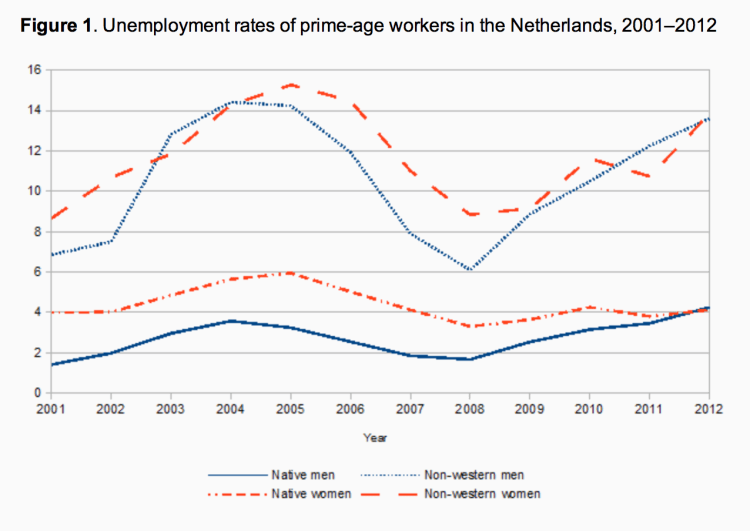
The evolution of the unemployment rates of prime-age (25 to 54) non-Western immigrant workers over the past decade is shown in Figure 1. The differences with prime-age native workers are substantial. Whereas the native male workers’ unemployment rate went up from 1.5% of the labour force in 2001 to 3.5% in 2004, over the same period it went up for non-Western prime-age males from 7% to 14%. After that, unemployment rates dropped to reach the lowest point in 2008 with 1.8% for natives and 6% for non-Western immigrants. In 2012 unemployment rates for prime-age individuals were up to 4% for natives and 14% for non-Western immigrants.
To analyse the impact of the Great Recession on unemployment, we use data from the LISS (Longitudinal Internet Studies for the Social sciences) panel.
As figure 2 shows, the development of unemployment rates corresponds to the developments in the Dutch labour market during the observation period. At the beginning of the year 2009, unemployment rates started to rise. The unemployment rate of native workers went up from 5% to 8%, whereas the unemployment rate of non-Western immigrant workers went up from 12% to 20%. In absolute terms there is a big difference in the increase in unemployment. However, as Figure 2 suggests, in relative terms the increase was comparable.

Chosen excerpts by Job Market Monitor. Read the whole story at




 Job Market Monitor
Discussion
No comments yet.